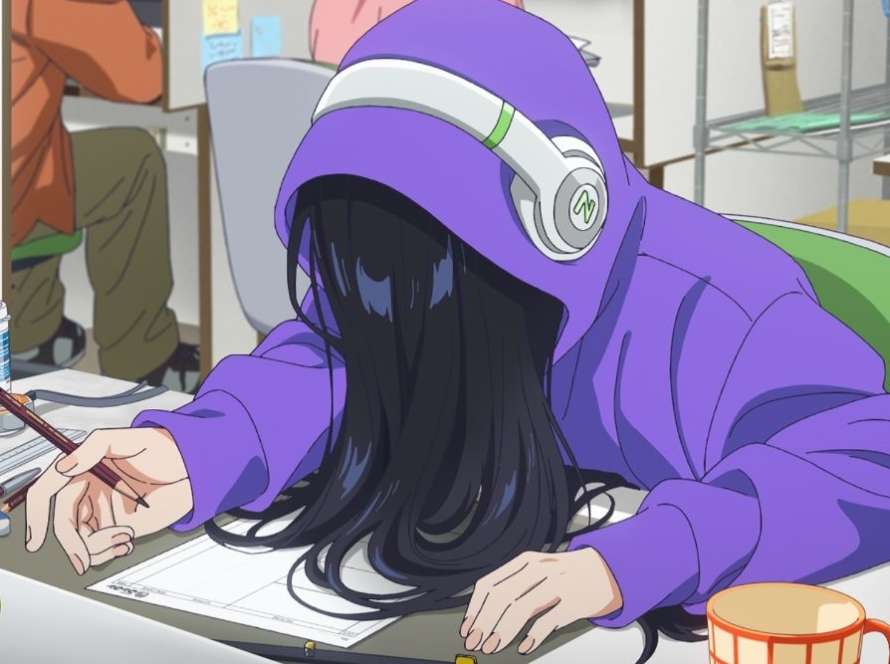

My Dress-Up Darling / Kisekoi was always charming, but it has reached a new level with a sequel that’s more wildly creative, thematically tighter, and in that process, more diverse in the subcultures it explores. Let’s dig into the production changes that paid off so extraordinarily well!
The first season of My Dress Up Darling / Sono Bisque Doll wa Koi wo Suru, which we’ll be referring to as Kisekoi to save us that mouthful of a title, was a perfectly reasonable adaptation of an enjoyable series. It was, however, a bit of a reductive encapsulation of what the original work encompasses. Mind you, that’s not always a negative aspect, let alone a deal-breaker. If anything, you could argue that it’s natural for adaptations to come across like that; it’s much easier to design a tightly focused experience with the foresight of long ongoing or even finished publications, whereas original authors who have only just started their work wrestle with the unknown. Certain series have been demonstrably improved through their adaptations because of that, be it by shedding elements that in retrospect were an awkward fit, or through mere choices of emphasis.
When it comes to Kisekoi, though, I don’t believe that was the case. Again, don’t take this as harsh criticism of its first TV show, which was solid overall. Anyone who has seen it can attest that its delivery ranged from technically sound to sometimes exceptional, with animation standards comfortably above the norm of current TV anime. And yet, the arrival of its sequel demonstrates the existence of a broader potential that they couldn’t tap into the first time through.
Season 1’s relative narrowness began with an aspect that you can hardly fault the creative team for: the episode count. With a single cours to their disposal, the staff made the best choice available to them and proceeded at a measured pace, even though that meant they wouldn’t reach the arcs (the most recent ones at the time) where the manga truly hits its stride. Albeit always enjoyable, Shinichi Fukuda’s work takes a while to elevate itself from a cute romantic comedy that states a message that sounds nice, to one where those beliefs ring across every page with the type of conviction you can’t help but buy into.
In more specific terms, this means that the series gradually broadens its horizons in its depiction of cosplay and otaku culture as a whole. Its respect for the former could never be put into question; more than a few chapters of the series, including those earlier stages, are so thorough in their depiction of the hobby that they could serve as tutorials. This translated into the first season of the anime as well, offering an unquestionably loving look at the subculture… or rather, into the slice of it present in the material they’d have time to adapt. That was enough to gesture toward ideas like proactive fandom and derivative creation as valuable ways to channel your love, as well as the pushback against societal pressure about what we ought to like. While those are themes that naturally accompany Gojo and Marin across their budding romance, they’re still not fully formed at this stage. The concepts feel somewhat detached from the highlights in the production, and simply not all that connected to the realities of most people within the culture it explores. Those themes are, in short, adequate window dressing for a cute romcom.
To some degree, that narrowness in flavor comes down to the execution. If I tell you to close your eyes and imagine a few memorable sequences from the first season, I know for a fact that some combination of bouncy, volumetric depiction of Marin’s body in skimpy clothes popped up in your mind. This is not an attempt to shame perverts among our readers—in sites aimed at appreciation of art, perversion is kind of a badge of honor in the first place. What I mean to say, though, is that those sequences received a level of memorable, clearly outstanding delivery that the series couldn’t afford on the regular. It’s an unevenness in impact value (even with the floor still being respectable) that gives off the false impression that those moments are all that the series is about.
It’s worth noting that, when looking back on the first season for a series of Febri interviews, series directorSeries Director: (監督, kantoku): The person in charge of the entire production, both as a creative decision-maker and final supervisor. They outrank the rest of the staff and ultimately have the last word. Series with different levels of directors do exist however – Chief Director, Assistant Director, Series Episode Director, all sorts of non-standard roles. The hierarchy in those instances is a case by case scenario. Keisuke Shinohara admitted to initially assuming Kisekoi was merely eye candy for guys. It was only when he read further that he found himself deeply drawn to Gojo’s struggles as a creator; despite being in different fields, he found his arc to resonate with anyone invested in making things. It was also by delving more into the series that he came to appreciate the portrayal of Marin’s feelings in a definite, equally important way—a contrast with the danseimuke romcom trend of framing women as unknowable objects of pursuit. This appears to be a sentiment shared across the team, as Aniplex chief producer Nobuhiro Nakayama recently referred to the series’ shoujo-like energy because of it.
That said, there being more aspects to the series doesn’t mean that eroticism hasn’t always been part of Kisekoi. We’re following two teenagers, each from their own angle of awkwardness, trying to figure out their sexuality. One of them is confident enough in her body to attempt to cosplay for provocative characters from adult games; highlighting the relationship between a series with this theme and the depiction of bodies, as well as the fact that she quite likes porn games. And, what’s arguably most important, Fukuda doesn’t hide that she enjoys depicting Marin in a sexy way. Given this premise and the team’s access to a few exceptional character artists who’ll happily go all out on those sequences, it’s neither a surprise nor a downside that many highlights in the first season correspond to racy Marin cuts. If we’re purely judging the execution, the issue is more about—whether due to perception or relative weakness—it’s the other sides of Kisekoi S1 that didn’t hit with the same strength.
For starters, it’s important to remember the context of that first season’s production. While well-made for TV anime standards, we can’t forget that it followed the absolute implosion of Wonder Egg Priority. Although Shouta Umehara’s ambition as an animation producer fuels what’s undoubtedly CloverWorks’ most prestigious team, he has on occasion overdone it to the point of also becoming troublesome. He’s by no means a cruel leader who exploits others, but rather the rash type who spearheads even the suicidal missions; don’t forget that the person WEP sent to the hospital was himself. His attitude at the time is something that has been gradually evolving—in ways that would later affect Kisekoi’s second season—but more than anything else, it was that post-WEP mental and physical exhaustion that dragged the standards for their next project back down to earth. Kisekoi’s first season accepted a lower threshold of consistency and quality for the character art, and rather notoriously, featured two fully outsourced episodes (#03 to Traumerei Animation Studio and #07 to Lapin Track). It’s a solid production, yet also the very definition of holding back. Given this context, understandably so.
Another reason why the occasional Marin shot stood out above most everything else, and the reason why we introduced the idea of perception earlier, is that series directorSeries Director: (監督, kantoku): The person in charge of the entire production, both as a creative decision-maker and final supervisor. They outrank the rest of the staff and ultimately have the last word. Series with different levels of directors do exist however – Chief Director, Assistant Director, Series Episode Director, all sorts of non-standard roles. The hierarchy in those instances is a case by case scenario. Shinohara is inconspicuous by nature. The beginning of the first season was already enough to illustrate that, even when he’s using exaggeration, he does it in such a calculated way that you take his compelling delivery for granted. Through technique and wit, he uses his position as the director to protect the viewer’s immersion from ever shattering. He may not be a strict realist, but he’s got the type of grounded vision that compels him to portray figurative spotlights in the way you would show real lights. While he never set aside the sense of humor of the original work, it was other episode directors in the first season who leaned more ostensibly onto it. Especially back then, Shinohara was happy to aim for a feeling of transparency; being authentic in the portrayal of people and the subject matter, leaving the artifice up to others.
When it comes to that first season, episodes like #11 offered the type of friction that Shinohara is more naturally averse to; following the lead of a certain director who was later put at the forefront of the sequel, it showed a cheekier Kisekoi that was willing to play with the farcical nature of characters as 2D assets you can toy with. But, from an entirely different angle, the true highlight was the eighth episode led by Yusuke Kawakami. Early on, a lengthy scene key animated by Kerorira showcases the type of charismatic depiction from the sheets that we otherwise only see in spicy scenes during season 1. As you venture further into the episode, the depiction of an older magical girl series makes concessions to authenticity in favor of the rule of cool. A much more palpable sense of atmosphere than what you encounter across the rest of the show oscillates between dread and vulnerability when a character opens up to Gojo, then shifts just as quickly to hilarious visual hijinks.
In contrast to Shinohara’s inconspicuousness, Kawakami’s storyboardStoryboard (絵コンテ, ekonte): The blueprints of animation. A series of usually simple drawings serving as anime’s visual script, drawn on special sheets with fields for the animation cut number, notes for the staff and the matching lines of dialogue. More is the type to proudly stop you in your tracks. There’s a shared sense of elegance that allows it to exist within the series director’s framework, but the execution is much more ostentatious and overt. Look no further than Juju’s breakthrough over her identity and dreams, conveyed through a clear overlap of her reflection and a magical girl outfit. The entire final segment with Marin and Gojo on the beach is an ethereal portrayal of firsts; of first love, first outings at the beach, and first time you get disrespected by a seagull, because it remains silly even with those otherworldly vibes Kawakami and the rest of the team granted it. The episode features, top to bottom, superlative craft and thoroughly memorable delivery within a season where the peaks tend to otherwise come in one singular flavor.
There’s no denying that there’s a fundamental difference between the direction of a dazzling individual like Kawakami and Shinohara’s steady hand. The series directorSeries Director: (監督, kantoku): The person in charge of the entire production, both as a creative decision-maker and final supervisor. They outrank the rest of the staff and ultimately have the last word. Series with different levels of directors do exist however – Chief Director, Assistant Director, Series Episode Director, all sorts of non-standard roles. The hierarchy in those instances is a case by case scenario. himself has alluded to it, as seen in one of the many interviews held for the Kisekoi S2 feature on Newtype September 2025. Given his thoughtful but ultimately kinda quiet style, Shinohara humbly denies having the type of gravity of his more charismatic peers. While there is a pattern in this industry where magnetism correlates to flamboyancy, Shinohara happens to be demonstrably wrong—as seen by the way that those more publicly renowned stars chant his name whenever it comes up in the news, showing appreciation for his craft in a funny way. It may not stand out in the same way, but Shinohara’s technical precision is greatly appreciated by those who work alongside him. And if he were to be placed in a more favorable environment, with a bit more experience under his belt as well, he could win over viewers with just as much enthusiasm. His greatness may be trickier to grasp than with those more overt star directors, but his charm is no less.
And thus, cue Kisekoi Season 2, the project that has allowed Shinohara to live up to that potential.
If you were surprised by the way that this sequel improves in essentially every single area, you had the right mindset. Barring the rare staff replacement that pans out for the better, the more natural outcome for sequels is to begin a slight downward trend. Maintaining its original level or even a slight improvement are in the cards, but anything more hopeful than that flirts with delusion. To put it simply, it’s common for initial projects to be synonymous with the strongest investment and more potent teams; after all, long-term commitment of skilled staff is the trickiest to secure, and by nature, sequels come with either an already secured fanbase or the certainty that the series isn’t a hit. It’s not as if there are no examples of second seasons being stronger, more compelling works, but you certainly can’t take big upgrades in the production department for granted.
What was it that allowed Kisekoi to make such a clear leap, then? We’ve already mentioned some reasons that came into play. It’s worth remembering that this is only Shinohara’s fourth attempt at series direction, and that the first two instances happened to be Black Fox (where he was sort of a replacement for the busy Kazuya Nomura) plus the collapsing husk of A3 that he shared with another up-and-coming director, Masato Nakazono. Kisekoi feels like his first attempt to lead a serious project, so a sizable improvement by the time of the sequel is reasonable. Especially when, compared to that post-WEP depression, this project arrived at a time when Umehara’s production line and certain parts of CloverWorks are… flourishing as much as you can while being demonstrably too busy, let’s say. Not ideal, yet clearly a better environment for a more mature series directorSeries Director: (監督, kantoku): The person in charge of the entire production, both as a creative decision-maker and final supervisor. They outrank the rest of the staff and ultimately have the last word. Series with different levels of directors do exist however – Chief Director, Assistant Director, Series Episode Director, all sorts of non-standard roles. The hierarchy in those instances is a case by case scenario..
Jumping straight onto the first episode of season 2, meaning Kisekoi #13 following the official numbering, showcases those substantial improvements all across the board. Shinohara never shed his tendencies, but as he explained in the aforementioned Newtype interview, he wanted to broaden the range of expression. In his view, the occasional betrayals of objective reality make things more interesting for viewers and creators alike. Armed with that new mindset—and the collaboration of a certain key member in season 2’s team—he set off to storyboardStoryboard (絵コンテ, ekonte): The blueprints of animation. A series of usually simple drawings serving as anime’s visual script, drawn on special sheets with fields for the animation cut number, notes for the staff and the matching lines of dialogue. More and direct this reintroduction to the series.
If you intend to gauge Shinohara, the brilliant scene at the end of the episode might be the best example of what he’s capable of this time around. Surrounded by extroverts in the Halloween party he’s been dragged into, Gojo is forced to face his insecurities; does he really belong with them, and actually, does he belong anywhere when his interests don’t conform to gender norms? Those fears are delivered through precisely timed text as we delve into his psyche, showing his usual technical excellence but also that desire to increase the abstraction. Shinohara succeeds at this new challenge of evoking something larger than the material reality of the scene, and at the same time, still plays within the confines of its setting in an amusing way. After all, this entire scene goes on for minutes as you can hear everyone’s favorite Nowa singing (rather Haruhily) in the background. And so, after transitioning from Gojo’s fears to a pleasant feeling of acceptance, the climax of the song lets her immediately pivot to a hilariously mistimed, public question about whether the two leads are dating. Bless you Nowa, and bless you Shinohara.
80 cuts around the karaoke scene, including virtually every appearance of Nowa, were drawn by Hirohiko Sukegawa. This is no coincidence: he called dibs on his favorite character as much as possible, extending his duties even beyond the show itself. The team allowed him to draw a whole lot of extra illustrations to accompany Nowa’s covers of rock songs (why does she have such great taste?) across season 2, to the point that the original author picked up on his very focused efforts. And so, as the season was ending, she drew Nowa in oshikatsu mode… over real animator Sukegawa, who predictably lost his mind about it. Also, while we’re talking about the above clip, the way that the names and ages are listed sure feels reminiscent of an iconic FLCL scene. I suspect a certain assistant series director came up with this detail.
Just as the ending of the episode is excellent, so is the beginning. This structure is, in the first place, a great move by the adaptation. Much of the second season’s early stages is built upon small shifts of the source material’s flow, and I believe that they succeeded in their goals; in the case of the first episode, to welcome us back with something that encapsulates the totality of Kisekoi’s charm, rather than proceeding as if no break had happened. And so, just like its predecessor occasionally did, season 2 starts off with a ridiculously fun genre parody led by Kai Ikarashi—one that also serves to bid goodbye to the late art directorArt Director (美術監督, bijutsu kantoku): The person in charge of the background art for the series. They draw many artboards that once approved by the series director serve as reference for the backgrounds throughout the series. Coordination within the art department is a must – setting and color designers must work together to craft a coherent world. Ryo Konno.
As the series’ scope broadens, so do these amusing peeks at its in-universe pieces of fiction. They encompass more corners of the otaku map and become more fleshed out, especially within an adaptation that imagines them way further than the glimpses within the manga. Following Ikarashi’s pen, this one becomes more… everything. More. That’s essentially how Shinohara talks about his pal Ikarashi: someone you can trust not just to get what your storyboards allude to, but who’ll then outdo you by expanding it way further. TsuCom is a hardboiled yet goofy series that is supposed to make you go Damn, that was fun, and that’s exactly what Ikarashi’s work conveys.
Although Shinohara came up with the rough idea for that scene, it was someone else who cleaned it up into a proper storyboardStoryboard (絵コンテ, ekonte): The blueprints of animation. A series of usually simple drawings serving as anime’s visual script, drawn on special sheets with fields for the animation cut number, notes for the staff and the matching lines of dialogue. More. That same person fed him ideas across the entire season, becoming arguably the main culprit for the change in Kisekoi’s tone. It’s finally time to talk about fan favorite Yuusuke “Nara” Yamamoto, who took a proactive stance in his newly acquired role of assistant series directorSeries Director: (監督, kantoku): The person in charge of the entire production, both as a creative decision-maker and final supervisor. They outrank the rest of the staff and ultimately have the last word. Series with different levels of directors do exist however – Chief Director, Assistant Director, Series Episode Director, all sorts of non-standard roles. The hierarchy in those instances is a case by case scenario.. As he notes in the Newtype interview that he shares with his good friend and main animator Naoya Takahashi, the scope and specifics of that role vary heavily depending on the environment and given project. In this case, Nara’s reach was all-encompassing in the way that normally only the project leader’s is; ever-present as early as the script meetings, and involved in choices for episodes where he wasn’t credited explicitly as well. Granting anyone that much involvement ought to have an effect, let alone a creator with as bold a personality as Nara’s.
In that interview, Takahashi highlights Nara’s qualities as a director as something unique for his background. I would largely agree with his view that, whenever outstanding character animators transition into directorial roles, they tend to place a lot of emphasis on the beauty and technical soundness of shots, the authenticity of the acting, and the mechanical flow of storyboards. Those are, of course, positive qualities—and also a side that Nara hasn’t truly lost. In the process of shifting roles, though, he has become an artist much more invested in the simple idea of entertaining the audience and taking them by surprise. This is something that fans of Bocchi the Rock came to really appreciate, as his episodes in the first season were among the least orthodox for what was already an eccentric comedy. However, it’s worth noting that the desire to catch viewers by surprise with a diversity of materials is something Nara exhibited beforehand (even in a different Bocchi show!).
Within just one episode, the reasons that allowed Kisekoi to level up this much are spelled out rather clearly. It’s not one singular cause, of course. We’ve talked about Shinohara’s growth, the shift in his approach, and how the arrival of Nara further fueled both. If we take a step back, it’s impossible to dissociate this last point from the current state of Bocchi the Rock; an unplanned limbo that has caused not just its staff but also the energy they carried to spill into Kisekoi.
While there always was overlap between these projects as two series handled by Umehara’s gang, the way that its personnel and comedic edge took over Kisekoi S2 speaks for itself… as does the fact that Bocchi’s designer Kerorira went from an occasional animator to earning the position of Team Support. According to Umehara, that credit is meant to reflect his current standing as someone who transcends projects within the studio. In short, he’s a reliable figure with the decision-making and communication abilities to help anytime, on top of his ability to draw a lot.
When it comes to Kisekoi S2, that more tangible workload amounted to a solo key animated opening, effects assistance for their in-universe games, clean-up on the heaviest episodes, and large chunks of key animationKey Animation (原画, genga): These artists draw the pivotal moments within the animation, basically defining the motion without actually completing the cut. The anime industry is known for allowing these individual artists lots of room to express their own style. to bookend the season. For this first episode, what stands out the most is the sequence where a rather messy Marin goes through an emotional rollercoaster by letting her imagination a bit too loose; almost like Kerorira had endlessly animated a pink creature who experiences that on the regular. Shout out to the last cut as well, with everyone else picking up on Marin’s eccentric behavior right as a wave of organic background animation hits the windows. Shinohara-ish precision in capable animation hands!
For as much as artists like him stand out, it’s important to establish that the great increase in production values is all-encompassing, extending beyond any individual. Again, this is something closely tied to the context of season 2’s production when compared to its predecessor. Although we can’t underplay the fact that CloverWorks is in a state of overproduction, especially as the studio tries to frame that as a positive given the results they obtain, it’s also undeniable that there are tangible improvements to their infrastructure. Their staff training (and sometimes aggressive poaching) has helped build a studier, better prepared team. Building on that solid ground rather than within the crater that WEP left behind, the support was simply that much stronger.
Although it was solo key animated by Kerorira, the opening was directed and storyboarded by Yuki Yonemori. Its charming integration of production credits catches the eye, though I believe the heart of the sequence is the emphasis that he placed on physical materials—something of utmost importance in a series about cosplay. It’s worth pointing out that the sequence borrows many compositions from NO LULLABY, a music video that I’m sure someone as tapped into worldwide animation as Yonemori had seen many times. I believe that the way they’re processed is transformative and comes across as a respectful nod, though it would have sat better with people if they’d shouted out the original team. Given the unspoken rules about explicit mentions of other works, the idea may have been regrettably shot down.
Don’t get me wrong, though: Kisekoi S2 is uniquely successful. Although I believe that Bocchi’s amusing creativity propels it to the very top of Umehara’s works, there is an argument to be made about the careful precision—not at odds with just as lively an execution—across most of Kisekoi S2’s making it this team’s greatest production. Shinohara himself deems the standards for episodes like season 2’s premiere to be excessive for television. He didn’t only mean the most visible aspects like detail and polish of character art, or even the degree of articulation of the animation, but also the lavishness of the in-betweening and painting. The lengthy time spent on the earlier episodes certainly helps, though the director also points out that the high baseline of technical skill greatly reduced the need for retakes, thus making that degree of ambition feasible. Perhaps, the best way to describe their success is that it feels like a very finely tuned season; part of that secret being, like he revealed, a team so good that they nailed many things first try.
That finesse carries over to the second episode of the season, which otherwise makes a noticeable tonal swing. One of the main points you need to grasp to appreciate the noticeable change in flavor between Kisekoi seasons is that Nara was genuinely everywhere, tagging along with a series directorSeries Director: (監督, kantoku): The person in charge of the entire production, both as a creative decision-maker and final supervisor. They outrank the rest of the staff and ultimately have the last word. Series with different levels of directors do exist however – Chief Director, Assistant Director, Series Episode Director, all sorts of non-standard roles. The hierarchy in those instances is a case by case scenario. who was happy to absorb his ideas. And yet, just like the concentration of oxygen in the atmosphere can fluctuate, so can the density of outrageous director particles (real scientific concept). Those tend to be at their highest, of course, in the episodes that Nara personally directed and storyboarded—meaning #14, #19, and #23.
After the premiere’s choice to rearrange events so that viewers were welcomed with a fuller dose of Kisekoiness, this follow-up returns us to an adventure we’d skipped. The readjustments require taping together two distinct stories, but Nara’s delivery is so confident that you’re not left feeling like there was no clear vision behind it. Sure, we switch from the continuation of the romcom beat about whether they’re dating to cosplay and gender focused plotlines, but both are delivered through similarly eclectic mixes of styles.
Nara is always willing to pivot from Kisekoi’s grounded normality to his reminders that animation is composed of assets he can play around with. There’s that familiar sense of comedy built upon quick stylistic shifts whenever he can find a way to sneak it in; changing levels of stylization, of fluidity in the animation, and then subverting your expectations from an entirely new vector when you think you’ve cracked the pattern. Just like the Bocchi anime that episodes like this are so reminiscent of, it’s the consistent sense of surprise that becomes the glue between heterogeneous parts.
Since we talked about the opening sequence, we ought to introduce the ending as well. The closing sequence by VIVINOS is very reminiscent of their Pink Bitch Club series, taking Marin’s crush and her interest in fashion as an excuse to turn her into a bit of a menhera menace.
If we stop and appreciate the once again excellent animation, we can find plenty of examples of seemingly uncanny combinations of ideas leading to a richer outcome. With a director as quick to embrace cartoony aesthetics, you could assume that’s the route it’ll head in whenever there are comedic needs, but Nara successfully guides the team to get mileage out of less common approaches. Like, for example, ever so slightly dialing up the realism to make a sequence more amusing. As an embarrassed Marin storms away from Gojo, the level of lifelike detail in which the folds of his disguise are depicted—a bit exaggerated but not so much that they become a caricature—makes him look much creepier and thus funnier in this context. Even when the application of a style is more orthodox, the ability to alternate between them will keep you constantly engaged. After all, the same visit to a sick Marin can have outstanding examples of precision in animation and inherently funny betrayals of space. In a season with many outrageous visual tricks, even the seemingly more standard sequences can be inherently fun to look at.
One detail we’ve neglected to mention is that all those scenes arrived by the hand of the aforementioned main animator, Naoya Takahashi. Speaking to Newtype, he simplified the evolution of his role as going from a tactically deployed weapon across important moments in the first season, to handling large chunks at a time for the sequel. This is not to say that he no longer handled climactic moments, since we’re talking about an animator with a hand in the very last scene of the season. However, it’s true that he halved his appearances so take he could take over many cuts whenever he showed up as either key animator or supervisor.
Applied to episode #14, that meant drawing key animationKey Animation (原画, genga): These artists draw the pivotal moments within the animation, basically defining the motion without actually completing the cut. The anime industry is known for allowing these individual artists lots of room to express their own style. for virtually every single shot in the first half; the only small exceptions being Odashi and the regular Yohei Yaegashi making cute guest appearances, in rather different ways. Nara is particularly effusive about Takahashi’s mindset, as an animator whose interests are tickled by seemingly troublesome cuts that he’ll complicate even further, but it’s worth noting that the entire second half received the same holistic treatment by Maring Song. Given that its animation demands are just as diverse, the challenge couldn’t have been any easier.
Even with those assistants and the help of a solid lineup of 2nd key animators, having the episode’s two animation directors penning every single cut in the first place is quite the ask. And keep it in mind: it was an ask, not a spur-of-the-moment happening but a foundational idea in planning Kisekoi S2. Those Newtype features confirm as much, saying it was an episode conceived to be animated by a small team. While this one is noteworthy in how far they went with it, the desire to keep animation teams small is a defining trait of Umehara’s production line in recent times. From a creative standpoint, there’s an obvious reason to chase that goal: the natural sense of cohesion and full realization of a better-defined vision that you can get out of small teams. And from a management level, the idea that you may be able to offload this large a workload to just a few people—at least for certain tasks—is a dream come true.
 The thing about dreams, though, is that they don’t always play nicely with reality. This approach that pushes back against modern anime’s messy, disparate, massive teams may have noble goals, but it can fuel a production’s downfall as well; or, as it has in some other Umehara projects, push individuals to the brink. If you simply do not have the schedule and tremendously qualified personnel across the board to make something ambitious with few people at a time, you risk a quicker implosion once things begin going wrong. After all, each person in trouble would be entrusted with a very sizable workload.
While it’s positive that viewers have started paying attention to the composition of teams (who is part of them, their size, roles, etc), many are a bit too quick to assume that seeing fewer animators credited is immediately a sign of a healthier, straight-up superior production. Instead, they should be asking themselves if such a team was a natural fit for the production circumstances, and whether the level of ambition and quality standards match their possibilities.
Circling back to Kisekoi S2, then, we can say that episodes like this manage to maintain—and occasionally even raise—the project’s already impressive technical floor despite the small team. And what about the larger picture? Did this approach eventually push the production off the rails? Although things got tighter by the end, we can now say that it weathered the storm without requiring the level of unthinkable individual feats that protected the likes of Bocchi. In that regard, it’s worth noting that Kisekoi S2 showed an interesting level of restraint. Small teams of animators, but never as far as this one episode. A mere two episodes with a singular animation director, instead opting for duos as its default. Part of this comes down to the improvement of CloverWorks’ infrastructure (not to be confused with their planning) that we talked about earlier, but it’s also about that evolution in Umehara’s mindset; away from his most aggressive tendencies, less allergic to the concept of compromising, and instead interested in finding ways to minimize the negative effects from that.
It’s another one of Umehara’s favorite weapons that takes over the show with the next episode: character animation ace Tomoki Yoshikawa, who makes his debut as storyboarder and episode director. If his peers viewed Nara as a very entertaining aberration, Yoshikawa embodies straightforward excellence in his breed. As an animator, Yoshikawa’s work feels performed in a way that few artists’ do; so specific in its posing and demeanor that you feel as if the characters were actors who’d just been briefed by the director. And now that he genuinely occupies that position, you get that philosophy applied to an entire episode—often through his own redraws. The way people interact with objects and people’s gestures constantly stand out as deliberate. The way he accomplishes it makes his ostentatious brand of realism not particularly naturalistic, but its technical greatness and sufficient characterfulness justify its braggadocio air. Perhaps this is the horseshoe he shares with Nara: one, a director so imaginative that he gets away with making the artifice painfully obvious, the other, an animator so good at articulating characters that he’s happy with showing you the strings with which he puppeteers them.
Despite yet another charismatic lead artist having a visible impact, Kisekoi S2’s overarching identity is too strong to ever disappear. Instead, what happens is that the two tendencies tend to mix with each other. Yoshikawa’s deliberate acting doesn’t risk coming across as too clinical and serious, as his precise posing occasionally becomes a source of humor as well; for an obvious example, a binoculars-like shot is followed up by the type of silly pose that Marin is likely to adopt when her nerdy side takes over. The switches to blatantly cartoony animation can occur without ditching the calculated staging, and for that matter, without ditching Yoshikawa’s pen either—he personally key animated some of them as well.
The real highlight of the episode, though, is in Amane’s backstory. At this point, it should be obvious that Yoshikawa is more than a cold, technically proficient animation machine. He once again shows that much with a stunning flashback focused on the main duo’s new friend and his encounter with crossplay, which helped him forge an identity he’s finally comfortable with. Through some of the most ethereal drawings in the entire show (many by Yoshikawa himself), we witness his first experiences with makeup, wigs, and dresses. We see neither his face nor reflection, but it quickly becomes obvious that it’s because his past, regular self was one that he’d never been comfortable with. It’s impossible not to feel the contrast with his current persona, highlighted by all the cuts to the present clearly showing a happy face after so much obscuration of his expressions. The Amane of right now, the person cosplaying a female character while hanging out with Marin and Gojo, is the self that he loves and proudly projects outward.
This type of conflict is by no means new to Kisekoi. After all, Gojo’s own insecurities are also rooted in traumatic rejection over his gendered interests; and of course, Marin being a widely beloved, popular girl with some very male-coded hobbies is the flipside to his situation. Up until now, though, none of those situations had been presented in such striking fashion. If we add to that the way that Kisekoi’s exploration of otaku spaces widens—and this is only the beginning—the message of acceptance that had always been attached to the series starts feeling more meaningful.
The following episode ventures further in that regard. Although it’s the first chance for the production to take a bit of a breather, one aspect took a lot of work and it very much shows: the depiction of PrezHost. As is the norm with this season, an in-universe work briefly depicted in the manga becomes a fully fledged production effort within its anime adaptation. The beautiful designs by WEP’s Saki Takahashi and the evocative compositions it dashes out when necessary sell the appeal of the series, though it’s the concept itself that feels most important.
Even though Kisekoi rejects conforming to the preconceptions about what individuals ought to enjoy according to their age or gender, constantly doing so while only ever portraying danseimuke fiction (or types of work otherwise largely tolerated by men) would make its plea for acceptance ring rather hollow. This makes their fancy depiction of a shoujo manga turned popular live-action drama such a great choice, because it feels like it understands what teenage girls and families alike—including some boys, awkward about it they are—would get really into. I have to admit that, given the extremely obvious Ouran vibes of this fake series, I’d have loved to see much more overt mimicry of Takuya Igarashi’s direction; at best, Mamoru Kurosawa’s storyboardStoryboard (絵コンテ, ekonte): The blueprints of animation. A series of usually simple drawings serving as anime’s visual script, drawn on special sheets with fields for the animation cut number, notes for the staff and the matching lines of dialogue. More and its SHAFT flavor merely evoke vibes that feel like a distant stylistic cousin. That said, beautiful animation dedicated to something that strengthens your whole series’ message is hardly a reason to complain.
 As we venture further into the school festival arc, episode #17 marks the return of Shin Wakabayashi to television after a 4-year limbo. It hasn’t been a period of complete silence, since he has had a mentorship role within CloverWorks and very occasionally directed a side project, but the reduction of his output has been drastic. We framed the production of Kisekoi’s first season as the understandable restraint after Wonder Egg Priority’s collapse, so it feels rather appropriate that its much stronger sequel features WEP’s director storyboarding what is perhaps the greatest episode.
Between WEP’s early moments of excellence and his work across the 22/7 short films, Wakabayashi earned himself a reputation as a breathtaking director, the type that invites you into ethereal spaces where mundanity feels divine. Mind you, there is still plenty of room for delicacy and elegance across his boards here. Within an arc that strongly emphasizes collective work and the reliance on everyone’s specific skills, episode #17 allows the fundamentally subdued animation to do the talking; Gojo’s expert movements contrast with Marin’s well-meaning flubs, yet she’s the one who irradiates confidence with her body motion when she’s in her field. The intricacies of seemingly mundane animation tell us a lot, just by swinging from one of Marin’s beastly lunches to Gojo’s delicate eating as drawn by Shinnosuke Ota. Even that otherworldly vibe of Wakabayashi’s direction is channeled through the depiction of light, dyeing the profiles of the lead characters when they’re at their coolest and most reflective.
However, those are merely the gifts that you’ll find hidden within the bushes—or rather, in a very exuberant, colorful jungle. Wakabayashi and episode director Yuichiro Komuro, an acquaintance from WEP who already did solid work in Kisekoi S1, meet this sequel on its own terms. Stronger comedic edge, but also the incorporation of different genres we hadn’t explored before? Playful emphasis on the farcicality of animation assets, as well as a much higher diversity of materials? If that is the game we’re playing now, Wakabayashi will happily join everyone else. And by join, I mean perhaps best them all, with a single scene where Marin squeals about her crush being more densely packed than entire episodes; horror buildup, an imaginative TV set, slick paneling that breaks dimensions and media altogether, and here’s a cute shift in drawing style as a final reward. Wakabayashi may be playing under someone else’s rules, but he’s far from meek in the process. Episode #17 is out and proud about being directed, with more proactive camerawork than some hectic action anime and noticeable transitions with a tangible link to the narrative.
For as much as episodes like this rely on the brilliance of a special director, though, this level of success is only possible in the right environment. This is made clear by one of the quirkiest sequences: the puppet show used for an educational corner about hina dolls. The genesis is within Wakabayashi’s storyboards, but the development into such a joyful, involved process relied on countless other people being just as proactive. For starters, the animation producer who asked about whether that sequence would be drawn or performed in real life, then immediately considered the possibility of the latter when Wakabayashi said it could be fun. There’s Umehara himself, who’d been watching a documentary about puppeteer Haruka Yamada and pitched her name. The process this escalated into involved all sorts of specialists from that field, plus some renowned anime figures; no one better than Bocchi’s director Keiichiro Saito to nail the designs, as dolls are an interest of his and he has lots of experience turning anime characters into amusing real props. Even if you secure a unique talent like Wakabayashi, you can’t take for granted the willingness to go this far, the knowledge about various fields, and of course the time and resources required for these side quests.
 This might come as a surprise coming from a site built around the appreciation of animation, but I believe episode #18 to be a bit of a downer. The climax of the school festival arc does live up to its prestigious lineup in some ways, admittedly. After that curious guest appearance in the previous episode, Saito shares storyboarding duties with Bocchi comrade Nobuhide Kariya, who also acts as the episode director. The lineup of supervisors includes many of the deftest artists in the team, but above all, there’s character animation legend Keisuke Kobayashi in an elevated, non-standard role of animation director. Not one meant to just offer corrections to the drawings, but also provide guidance for the entire team and shape the philosophy behind the whole episode. You don’t need much technical knowledge to realize that it’s a stunning display of calculated, precise character animation. The leadership of an artist who’ll usually appear for a special moment that requires thorough movement results in the whole episode feeling like a technical animation highlight.
And yet, it’s that emphasis on clinical forms of animation that also makes it feel somewhat dispassionate—especially after the playfulness of Wakabayashi’s episode. The delivery is so fancy that it easily passes any coolness test, and it certainly has nuggets of characters as well; watching the shift in Marin’s demeanor when she’s performing makes for a very literal, great example of character acting in animation. But rather than leaning into the fun spirit of a school festival, the direction feels very quiet and subservient to an artist who can lean towards the mechanical. It’s worth noting that the most evocative shots in the entire episode, which break free from its cold restraint, come by the hand of Yusuke Kawakami. Those blues are a reminder of the way he already stole the show once, with that delightful eighth episode of the first season.
Kisekoi S2 is certainly not the type of show to dwell in impassionate technicality for too long, so it immediately takes a swing with another fun episode captained by Nara. A leadership that this time around doesn’t merely involve storyboarding and direction, but even writing the script as well. Given that the animation director is Keito Oda, it ends up becoming quite the preview for the second season of Bocchi that they’re meant to lead together. His touch can be felt through the spacious layoutsLayouts (レイアウト): The drawings where animation is actually born; they expand the usually simple visual ideas from the storyboard into the actual skeleton of animation, detailing both the work of the key animator and the background artists. and the character art itself, with scenes like the one at the karaoke feeling particularly familiar. A noticeably softer feel within a series where the designs normally lean in sharper directions.
Even though Nara mostly plays with regular tools for this episode, the same eclecticism we’ve been praising so far is all over the episode. At no point can you be sure about which technique, palette, and type of stylization he’s going to deploy when depicting Marin’s struggles. This helps spice up an episode that is otherwise a simple breather. Weight gain scenarios in anime rarely lead to a fun time; you don’t have to start considering whether they’re problematic or not to realize that they’re formulaic and repetitive. However, within a show where bodies are meaningfully explored and thanks to Nara’s amusing resourcefulness, it becomes yet another entertaining episode.
Additionally, there is a reason why we said that the director mostly uses regular tools in episode #19. The highlight is a sequence built upon a 3D scan of a real park, in a process that took 9 months to complete. Although there are technical points of friction like Marin’s lack of a projected shadow, this was a tremendous amount of effort applied to a fundamentally compelling idea. Within regular comics, a sudden switch to a series of identical panel shapes feels unnatural. In the context of a series about cosplay, that’s enough to tell that someone is taking photos. But what about anime (and more broadly, film) where the aspect ratio is consistent? A solution can be to reimagine the whole sequence as a combination of behind-the-camera POV and snapshots that don’t reject the continuity.
While on the surface it might seem like a more modest showing, episode #20 is—in conjunction with the next one—a defining moment of Kisekoi S2. Director and storyboarder Yuuki Gotou is still a bit of a rookie in this field, but may prove to be one of the best scouting moves for the team. Alongside the small changes in the script, the direction toys with the themes of the series in a way that casually solidifies the entire cast. Gojo and Marin attend a cosplay event and come across acquaintances, including multiple friend-of-a-friend scenarios. Those involve someone who, in the manga, is merely mentioned as having been too busy to attend. In the end, we don’t know much about her, and she doesn’t even register as a person. What does Gotou’s episode do, though? It transforms the manga’s plain infodumping about cosplay culture into a fake program that stars her as the host, which makes the eventual reveal that she couldn’t show up more amusing and meaningful; now she actually is a person, albeit a pitiful one. The delivery of the episode is enhanced by similar small choices, in a way that is best appreciated if you check it out alongside the source material.
The immediate continuity in the events links that episode to #21, which also underlines the essence of season 2’s success. I’m sure we’ve all witnessed discourse about anime’s self-indulgent focus on otaku culture at some point. The very idea of acknowledging its own quirks and customs is framed as an ontological evil, though really, those complaints amount to little more than cheap shots at easy targets that people can frame as progressive, refined stances. Were they truly that thoughtful about cartoons, people would realize that such anime’s common failing isn’t the awareness and interest in its surrounding culture—it’s the exact opposite. Anime isn’t obsessed with otaku, but rather with going through familiar motions and myopically misrepresenting a culture that is much broader than we often see. Every late-night show that winks at a male audience about tropes they’ll recognize is blissfully unaware of the history of entire genres and demographics; and for that matter, about the ones that it’s supposed to know as well, given how many gamified Narou fantasies fundamentally don’t understand videogames.
Due to Marin’s choices of cosplay and the unbalanced presentation of the first season, Kisekoi risked leaning a bit in that direction as well. But with a series that genuinely wants to engage with the culture it explores, and a team willing to push its ideas even further, that simply couldn’t come to pass. The most amusing example of this across two episodes is Marin’s cosplay friends, as women who feel representative of distinct attitudes seen in female otaku spaces. From the resonant ways in which proactive fandom is linked to creative acts to the jokes they make, there’s something palpably authentic about it. Nerdy women don’t morph into vague fujoshi jokes, but instead showcase highly specific behaviors like seeing eroticism in sports manga that read completely safe to people whose brains aren’t wired the same way. Kisekoi S2 gets a lot of humor out of their exaggerated antics—both #20 and #21 are a riot about this—but these are just one step removed from real nerds you wouldn’t find in many anime that claim to have otaku cred.
This exploration continues with the type of fictional works that motivate their next cosplay projects. Just like PrezHost felt like a spot-on choice for a group of regular teenagers, an indie horror game like Corpse is perfect for this nerdier demographic of young adults and students; if you wanted to maximize the authenticity, it should have been a clone of Identity V as that was a phenomenon among young women, but their slight departure still becomes a believable passion for this group. And most importantly, it looks stunning. Following the trend you’ve heard about over and over, a loosely depicted in-universe game becomes a fully-fledged production effort led by specialists—in this case, pixel artist narume. It’s quite a shame that, no matter how many times I try to access the website they made for the game, it doesn’t become something I can actually play.
The purposeful direction of Haruka Tsuzuki in episode #21 makes it a compelling experience, even beyond its thematic success. Though in a way, its most brilliant scene is still tied to that—Marin’s subjectivity being so clearly depicted is one of the ways in which Kisekoi pushes back against common failings of the genre, after all. When she misunderstands what Gojo is buying, diegetic green lights flash green, like a traffic light signaling his resolve to go ahead. Marin’s panic over the idea of getting physically intimate coincides not just with a camera switch to show an adults-only zone of the store nearby, but also with the lights turning red. She doesn’t exactly feel ready… but the more she thinks about it, the lights switch to pink. If I have to explain what this one means, please go ask your parents instead.
Season 2 thrives because of this broader, deeper depiction of cosplay as an extension of otaku culture. As we mentioned earlier, it makes the message of acceptance feel like it carries much more weight; with a palpable interest in more diverse groups of people, the words of encouragement about finding your passions regardless of what society expects you to do have a stronger impact. Since the preceding season faltered by focusing on arcs where these ideas were still raw, while also introducing biased framing of its own, there’s a temptation to claim that Kisekoi S2 is superior because it stuck to the source material even more. And let’s make it clear: no, it did not. At least, not in those absolute terms.
There is an argument to be made that it better captures the fully-developed philosophy of the source material; the argument is, in fact, this entire write-up. That said, much of our focus has also been on how Shinohara’s desire to increase the expressivity and the arrival of Nara have shifted the whole show toward comedy. Kisekoi has always had a sense of humor, but there’s no denying that this season dials up that aspect way beyond the source material. That has been, as a whole, part of the recipe behind such an excellent season.
And yet, we should also consider the (admittedly rare) occasions where it introduces some friction. If we look back at episode #20, one of the highlights in Gotou’s direction is the goofy first meeting between Akira and Marin. Since we’re taking a retrospective look after the end of the broadcast, there’s no need to hide the truth: Akira has a tremendous crush on her. However, their entire arc is built upon everyone’s assumption that she hates Marin, as she gets tense and quiet whenever they’re together. The manga achieves this through vaguely ominous depictions of Akira, which would normally be read as animosity but still leaves room for the final punchline. The adaptation mostly attempts to do the same… except their first meeting is so comedic, so obvious in the falling-in-love angle, that it’s impossible to buy into the misdirection. Every now and then, it’s in fact possible to be too funny for your own good.
If we’re talking about the relative weaknesses of the season, episode #22 is a good reminder that outrunning the scheduling demons—especially if you enjoy taking up creative strolls to the side—is hard even for blessed projects. Conceptually, it’s as solid as ever. Marin’s sense of personhood remains central to everything, with her own struggles with love and sexuality being as carefully developed (if not more) than anything pertaining to Gojo. Being treated to another showcase of Corpse’s beautiful style is worth the price of admission, and you can once again tell that Fukuda understands nerds as she writes them salivating over newcomers’ opinions on their faves. It is, though, a somewhat rougher animation effort despite all the superstars in various positions of support. While the decline in quality is only relative to the high standards of Kisekoi S2, seeing what caliber of artist it took to accomplish an acceptable result speaks volumes about how tight things got.
 In many cases, that type of schedule deterioration would be the beginning of the end. Fortunately, Kisekoi S2 still had enough in the tank to put together something spectacular. Who better than Nara to head the thematic climax in episode #23, which does a lot and somehow excels at every one of those challenges. It begins with a portrayal of Akira’s past that is reminiscent of Amane’s identity struggles, though more focused on age than gender. In his case and under Yoshikawa’s direction, the palette had highlighted the contrast between the warmth around a welcoming family and the coldness of the outer world, where we’re often forced to conform to societal expectations. Nara tweaks the colors from a more contrast-based perspective according to Akira’s state of mind, also using the spacious layouts in very effective ways; the emptiness of the hobby she has left behind clashing against the physically narrow spaces where she’s made to stay, being told that she’s too old for childish wastes of time.
Thanks to the small structural changes to the adaptation, this episode is able to reinforce the parallels between Akira’s situation and the world’s most beloved cosplayer Juju-sama (sentence collectively written by Marin and her sister). Sure, Juju’s got a supportive family and has been able to chase her dreams since an earlier age, but there have always been hints that she holds back somewhat. As a cosplayer with utmost respect for the characters, she never dared to attempt outfits where her body type didn’t directly match that of the original. This is why we see similar framing as that of a student Akira, feeling cornered before she stumbled upon a space to be herself. Nara may be an outrageous director, as proven by how quickly he unleashes paper cutout puppets again, but you can see his a subtler type of cheekiness in his storyboards as well; cutting to Juju’s shoes with massive platforms during a conversation about overcoming body types is the type of choice that will make you smile if you notice it.
On top of that thematic tightness and meaningful direction, episode #23 is also an amazing showcase of animation prowess. Separating these aspects doesn’t feel right in the first place; the compelling ideas rely on the author’s knowledge about the specifics of cosplay, which are then delivered through extremely thorough and careful animation. The likes of Odashi and Yuka Yoshikawa shine the best in that regard, though it’s worth noting that the entire episode is brimming with high-quality animation—and most importantly, with respect for the process of creating things as an expression of identity. Be it the Kobayashi-like acting as Juju storms out during a pivotal conversation about that, or a familiar representation of cosplay as a means to reach seemingly impossible goals by Hirotaka Kato, you can never dissociate the episode’s beautiful art from its belief that making things can allow us to be our real selves.
Again, it’s no secret that an episode like #23 was produced under strict time constraints; perhaps not in absolute terms, but very much so when you consider its level of ambition. In the context of not just this series but the production line we’ve been talking about all along, what’s interesting isn’t the achievement itself, but how it relates to an evolution we’ve observed before. Umehara’s more considered stance and CloverWorks’ improving infrastructure have been recurring themes, but there’s been one key piece of information relating to both that we’ve been keeping a secret. For as much as we’ve referred to this team as Umehara’s gang, which it very much is, you may have noticed that earlier we talked about a separate animation producer—the position that Umehara held in previous projects. So, what happened here?
As he has alluded to on Twitter but more extensively talked about in his Newtype interview, Umehara is not just aware of CloverWorks’ changes, but also quite hopeful about its up-and-coming management personnel. In his view, most of them are just one piece of advice away from figuring out the tricks to create excellent work. And yet, being the animation producer, he tends to be too far from the trenches for those less experienced members to come to him for advice… unless things have gotten really dire. That is, to some degree, simply not true; Umehara is too emotionally invested in the creative process to separate himself from it, no matter what his position at the company is. However, it’s correct that production assistants are more likely to go to their immediate superior rather than someone two steps above when they’ve simply got some doubts. And thus, Umehara has been the production desk for Kisekoi S2, whereas Shou Someno has replaced him in the producer chair.
The first-hand advice Umehara has been able to give will surely be meaningful for the careers of multiple production assistants. And just as importantly, Kisekoi S2 has been an excellent lesson for him. Right after the broadcast of episode #23, and even acknowledging the lack of time, Umehara expressed his delight about what the team had accomplished for the one episode where he was not at all involved in the management process. That future he dreamed of, where the quality of his production line’s output could be maintained without his constant presence, has finally come. Chances are that it could have come faster and less painfully if he hadn’t been so afraid of delegation before, if this team’s well-meaning passion had been channeled in more reasonable ways. Whatever the case, this feels like a positive change if we intend to balance excellent quality with healthier environments… as much as you can within the regime of a studio like this, anyway.
Our final stop is an all-hands-on-deck finale, with Shinohara being assisted by multiple regulars on the team. Though they all made it to the goal with no energy to spare, the sheer concentration of exceptional artists elevates the finale to a level where most people would never notice the exhaustion. The character art retains the polish that the first season could only sniff at its best, and the animation is thoroughly entertaining once again; a special shout-out must go to Yusei Koumoto, who made the scene that precedes the reveal about Akira’s real feelings for Marin even funnier than the punchline itself.
More than anything else, though, the finale shines by reaping the rewards of all the great creative choices that the season has made beforehand. In contrast to the manga, where Corpse was drawn normally, having developed a distinct pixel art style for it opens up new doors for the adaptation. The classic practice of recreating iconic visuals and scenes during cosplay photoshoots is much more interesting when we’re directly contrasting two styles, each with its own quirks. The interest in the subject matter feels fully represented in an anime that has gone this far in depicting it, and in the process, likely gotten more viewers interested in cosplay and photographyPhotography (撮影, Satsuei): The marriage of elements produced by different departments into a finished picture, involving filtering to make it more harmonious. A name inherited from the past, when cameras were actually used during this process.. Perhaps, as Kisekoi believes, that might help them establish an identity they’re more comfortable with as well.
Even as someone who enjoyed the series, especially in manga form, the excellence of Kisekoi S2 has been truly shocking. I wouldn’t hesitate to call it the best, most compelling embodiment of the series’ ideas, as the lengths they went to expand on the in-universe works have fueled everything that was already excellent about Kisekoi. It helps, of course, that its series directorSeries Director: (監督, kantoku): The person in charge of the entire production, both as a creative decision-maker and final supervisor. They outrank the rest of the staff and ultimately have the last word. Series with different levels of directors do exist however – Chief Director, Assistant Director, Series Episode Director, all sorts of non-standard roles. The hierarchy in those instances is a case by case scenario. has grown alongside the production line, especially with the help of amusing Bocchi refugees. Despite a fair amount of change behind the scenes and the exploration of more complex topics, the team hasn’t forgotten they’re making a romcom—and so, that stronger animation muscle and more refined direction also focus on making the characters cuter than ever. Given that we’re sure to get a sequel that wraps up the series altogether, I can only hope we’re blessed with an adaptation this inspired again. It might not dethrone Kisekoi S2, but if it’s half as good, it’ll already be a remarkable anime.

Support us on Patreon to help us reach our new goal to sustain the animation archive at Sakugabooru, SakugaSakuga (作画): Technically drawing pictures but more specifically animation. Western fans have long since appropriated the word to refer to instances of particularly good animation, in the same way that a subset of Japanese fans do. Pretty integral to our sites’ brand. Video on Youtube, as well as this SakugaSakuga (作画): Technically drawing pictures but more specifically animation. Western fans have long since appropriated the word to refer to instances of particularly good animation, in the same way that a subset of Japanese fans do. Pretty integral to our sites’ brand. Blog. Thanks to everyone who’s helped out so far!
Become a Patron!


gdrivenime
Berita Olahraga
News
Berita Terkini
Berita Terbaru
Berita Teknologi
Seputar Teknologi
Drama Korea
Resep Masakan
Pendidikan
Berita Terbaru
Berita Terbaru
Berita Terbaru