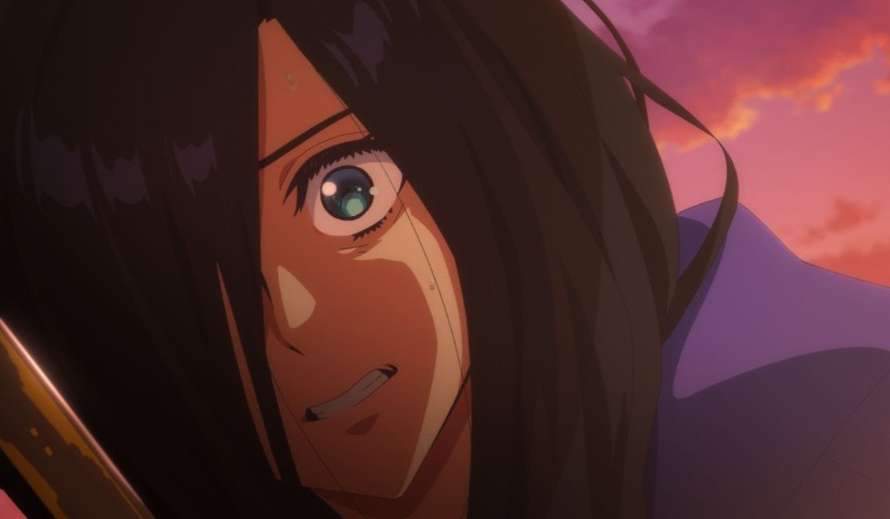

Now that the first arc of the Dandadan anime is over, we can look back at how it represents its series director’s extraordinary obsession with internal logic, the way that has enabled creative choices, and also the limitations that its team has to navigate.
In our first article about Dandadan, we focused on introducing the core members of the team as well as the motivations behind their creative choices. Chief among them was rookie series directorSeries Director: (監督, kantoku): The person in charge of the entire production, both as a creative decision-maker and final supervisor. They outrank the rest of the staff and ultimately have the last word. Series with different levels of directors do exist however – Chief Director, Assistant Director, Series Episode Director, all sorts of non-standard roles. The hierarchy in those instances is a case by case scenario. Fuga Yamashiro, whose artistic profile is so prone to misunderstandings that he himself has repeatedly attempted to clarify it. The director denies being a brilliant, radical auteur, instead painting himself as an extremely logical fellow; he would only have to add that he’s an awkward one to make Momo’s heart skip a beat. His peers thoroughly agree with that assessment, affectionately referring to him as an enshutsu otaku—a geek who obsesses over technical details, having collected the techniques of all the creators he admires and then built a directorial approach that’s all about repurposing those stored tricks.
Although we highlighted multiple aspects through which Yamashiro channeled that logical mindset, none of them stood out as much as Dandadan’s usage of color. After all, it’s hard to miss the screen being completely dyed in one color, or perhaps split into two that clearly represent a clash between a couple of characters. Based on the pointed usage throughout the premiere, having seen further episodes thanks to the prescreening, and also armed with the information provided by promotional videos, we made a few informed assumptions about Yamashiro’s vision. Which is to say, that we guessed his orderly approach had brought him to precisely regulate the usage of color, assigning one specific hue to every supernatural being.
Across the rather regular interviews that Yamashiro is giving—a perk of Dandadan being a popular series and its production advanced enough to allow him to—he has been addressing such creative choices with increasingly higher precision. While in the interviews we highlighted in the previous piece he focused more on the philosophy being his direction, by now (and thanks to a fair number of episodes already being widely released) the series directorSeries Director: (監督, kantoku): The person in charge of the entire production, both as a creative decision-maker and final supervisor. They outrank the rest of the staff and ultimately have the last word. Series with different levels of directors do exist however – Chief Director, Assistant Director, Series Episode Director, all sorts of non-standard roles. The hierarchy in those instances is a case by case scenario. can talk about how he chose to manifest those ideas. In the process, he has already confirmed our earlier speculation; not so much a sign of a keen eye on our side as it is proof that Yamashiro’s delivery is very clear in its intent. And, as it tends to be the case, the most interesting aspects were in the additional insights he shared.
Speaking to Mantan Web in this recent interview, Yamashiro first underlined the obvious: the radical color shifts are a visual representation of the act of stepping into the supernatural. In assigning each party in this paranormal cocktail a color of their own, they’re not only facilitating stark visual compositions when they clash, but also underlining the idea that those species or even individuals have their unique cultures and characteristics.
As we’d explored before, Dandadan’s eclectic mix of genres was born from the original author’s fondness of quirky crossover films like Sadako vs Kayako, which he expanded to include youkai, aliens—with a strong tokusatsu angle—and all sorts of psychic powers. Although the overlap between these otherworldly beings is part of the narrative itself, this exposes a bit of a binary in the premise; on the one hand, you have the earthly spirits, often tied to very local myths, and on the other, the extraterrestrial, genitalia-seeking invaders.
To represent that divide, Yamashiro and his team settled on assigning warm colors to the youkai fantasy and cold ones to the aliens on the sci-fi side. If you happen to have read the source material, rewatching the anime’s promotional videos will tell you that this is what they’re indeed doing… for the most part, as even the logical Yamashiro admitted that such rules must be tweaked for the sake of visually compelling execution. If you’re going to dye entire screens in a small number of colors to clash in interesting ways, you’d better choose them right. As he explained to Mantan, the first episode settling on a universally understood contrast of red versus blue was very much on purpose, so that they audience could get acclimated to this approach.
However, isn’t that precisely the type of capricious, convenient direction that Yamashiro proclaims to avoid? To some degree, the answer would be yes, but the truth is more complicated (and interesting) than that. For starters, it’s important to understand that there’s no clear dichotomy between directors guided by strict, regulated logic akin to Yamashiro and purely instinctual virtuosos. Look no further than Naoko Yamada, one of the creators we’ve written the most about on this site—and a curiously relevant one here, as the production of her latest film overlapped with Dandadan‘s at the same studio.
As we’ve explored before, Yamada’s experimental approach draws parallels between core elements of the narrative and scientific concepts; in Liz and the Blue Bird, two lead characters who fundamentally love each other but don’t see eye to eye otherwise are represented through the idea of coprime integers, which only share the number 1 as a common divisor. The personal becomes objective, outright mathematical, and that is then expressed through an equally wide-ranging mix. In that case, for example, by following the numerical route and conveying that mismatch through different bpm for the BGM that correspond to each character’s actions—which the animation then perfectly matches. That more calculated side is constantly spiced up with downright unpredictable artistry, like the usage of decalcomania to express the mirrored character tales.
Ultimately, Yamada’s appreciation of arbitrary mundanity prevents her from ever coming across as a storyteller who values rationality over everything. If anything, she’s not even fully sold on the idea that she must be a storyteller, because she’s perfectly comfortable in prioritizing the sensorial experience without traditional structure. Rules do exist in her works, which is why one of the lead characters in Liz tends to fiddle with her hair in a recognizable way, but they must not become a visible, unquestionable dogma; when asked about that gesture, she denied having a specific meaning depending on which side of her bangs she was touching because that level of certainty would turn her into a robot in the director’s eyes.
When Yamashiro calls himself a technically-minded director, then, it’s worth keeping in mind that this is not an absolute truth either. There’s no denying that it’s a strong tendency in his case, but his particular approach to directorial roles adds interesting friction to his clinical view. As an individual who has built an impersonal style by collecting techniques that other directors have used in their films, just to later disassemble and repurpose them for his own works, many of the tricks he’s borrowing have an inherent whimsy to them. Yamashiro may indeed not use a particular technique just because his instincts tell him that it feels right, but he’s inspired by directors who at the time deployed it for that reason, so playfulness is a part of Dandadan regardless.
Even beyond nuance and small contradictions to his philosophy, it’s also worth considering where Yamashiro points those logical needs. To put it plainly, the vast majority of viewers will never have a clue about the detailed reasoning behind every minute choice in his work, and the director is perfectly content with that. As long as the result stands to scrutiny if someone attempts to do so, and as long as his own cravings are satisfied, the goal will have been accomplished. Yamashiro may indeed avoid making a specific stylistic choice just because he thought it looked badass, but he’ll be happy to leave you feeling that it did, even if you don’t question the internal mechanics that enabled the coolness.
As we also wrote about previously, Dandadan is a pure entertainment work that the original author wrote after multiple failures to get serialized, at a point when his editor advised him to just let loose. Even if the director of the anime is allergic to the Rule of Cool, he’s giving his all to capture the experience of a series that is all about that. When we talk about his logical approach, then, we’re examining an attempt to rationalize an absurd series. While those competing perspectives would normally clash, Yamashiro’s resourcefulness allows him to build a logically sound scaffolding that reinforces the thrilling madness of the original work. At points, he simply has to go along with it—it’s a loudly fantastical series after all. However, whenever possible and with a degree of conviction you’ll rarely ever see in a newbie series directorSeries Director: (監督, kantoku): The person in charge of the entire production, both as a creative decision-maker and final supervisor. They outrank the rest of the staff and ultimately have the last word. Series with different levels of directors do exist however – Chief Director, Assistant Director, Series Episode Director, all sorts of non-standard roles. The hierarchy in those instances is a case by case scenario., he’ll go to extraordinary lengths so that everything is internally, materially coherent. Not an absolute law, but a strong, deliberate leaning.
By briefly returning to the first episode, we can appreciate the depths—and occasional limitations—of the director’s obsession with logic. We had previously discussed Yamashiro’s efforts to root his choices in the rules and possibilities of the world in a very tangible sense, in that attempt of his for everything to make sense. For example, we highlighted how those lighting and color depictions in the first episode were made diegetic as much as possible. What these newer interviews have made it clear, however, is that Yamashiro’s team is operating by building an invisible net of logical reasoning that facilitates one choice after the other, as if they were sequential. Again, the director is fine with the audience not being aware of any of that; he wants to provide a foundation that allows you to imagine how every little detail could happen within the world of Dandadan, but isn’t really concerned about explaining them out loud.
To exemplify this, we can simply consider Momo and Okarun’s separate adventures to chase the supernatural. As Yamashiro pointed out, the first thing we see in each of their locations is the moon—a warm yellow near the tunnel where he’s heading, and a very bright yet cold blue in the building she’s at. It’s obvious that this distinction is leading up to the eventual foes (and thus unique palettes) that the two will face, but doing this with no justification would rub the director the wrong way. So, how could he justify showing two demonstrably different moons, in the same night, at the same time, in relatively close-by locations?
Fortunately for him, a previous choice of his had enabled the solution to this new dilemma. As we’d also discussed before, Yamashiro had taken advantage of a gap in the original comic—the fact that we don’t see where their spaceship was—to turn the moon near the building into a camouflaged UFO. In turn, he felt like that was a fitting choice because those same aliens disguise themselves to appear natural, so they would likely do so with their vehicles as well.
By giving it this much logical thought, he reached a position where the arrangement of all these pieces is almost automatic. His logical cravings could be justified by adjusting details so that the two moons have a very good reason to shine in completely different colors; after all, one of them isn’t the moon at all, but rather the masked ship of a masked species. Beyond the solidification of the buildup, this also empowered Yamashiro to use the fake moonlight for storytelling purposes without having to worry about an intensity that wouldn’t be true to life at all. This is the iceberg of Yamashiro’s direction: a visible tip with compelling stylizations to reinforce the storytelling, and underwater, a massive body of logical rationalization. You can enjoy the former’s beauty with no awareness of what lies below, but it’s interesting to take a peek and notice how deep it goes.
Truth to be told, this mindset would normally be more of a limitation than anything else. Most noteworthy directors wouldn’t hesitate to apply similar color-coding and tweak the lighting simply because it fits the tone and the character beats they want to underline; some of them might not even put any of that into words, because they value imagination the most and naturally come to make these choices.
Personally speaking, I don’t think it’s necessary either—if anything, obsession with narratively justifying every directorial choice can easily lead to less compelling delivery, because you’re limited to what you can justify. What is most impressive here, then, is our rookie director’s ability to conveniently imagine what may exist within the natural gaps of the original work, which he can then use to support his additions to it in a coherent way. He holds a belief that arguably makes his job harder with remarkable strength, and when it comes to it, he has shown that he can succeed at this somewhat self-imposed challenge. We first summarized Yamashiro as logical, but resourceful is up there among his defining qualities.
If we move onto the second episode, that mindset is once again on full display. After all, Yamashiro is still storyboarding it, this time around with Rushio Moriyama as the episode director; someone you may know as Tsukushi Yama, an animator who first stood out in independent circles like Uguisu Kobo before going the commercial route alongside studios like Science Saru. The two of them set up a confrontation that is regulated similarly to the one in the first episode, right after Momo and Okarun retreat to the shrine where her family lives. As another extraterrestrial being pays them a visit, they isolate a series of elements from the manga as their starting point—namely, the fact that they’re encased by walls and that this new foe spews black, poisonous fog. Following Yamashiro’s vision of color-coding in ways that make sense in-universe, these dark elements naturally bring them to muting colors altogether, making the Flatwood Monster’s unique palette a black and white one that vaguely fits into the idea of a colder feel for the aliens.
As it tends to be the case with these stylistic choices, there is a visceral upside to the moment-to-moment experience, most notably in how it further highlights the dashes of red that correspond to Okarun and Turbo Granny’s powers. It’s also worth noting that, for all his talk about logic, Yamashiro sometimes appeals to the feelings in a more emotional, roundabout way. By his own admission, another reason why this episode’s fight is monochrome is the tokusatsu inspiration. Okarun’s own design had its red highlights increased in the first place because he wanted to evoke a certain hero’s design even more than the original did, and in this first fight with a bit of a kaiju flavor, he wanted the audience to feel like people did when they watched the first Ultraman series. While that series was technically filmed in color, Yamashiro believes that most people associate it with memories of watching it on older B&W TVs in the 60s, making this look immediately more evocative. Once again, we have proof that even with his strong leanings, the director is not a perfectly cold, calculating machine that can only work through facts.
Another consistent aspect of the direction is the characteristic pacing, which dials down from the breathlessness of the first episode to merely brisk during episode #02’s downtime. The show’s equivalent of a break to establish the setting is this rhythmic, very funny delivery of a walk back home, more laid back than anything in the premiere and yet constantly moving forward. On the other hand, its action continues to give you just enough time to be aware of the surroundings and thus enjoy the more puzzle-solving aspect of these fights, while otherwise being a frantic experience.
As much as moments like that stand out, though, Yamashiro’s regulation of the pacing through the storyboards is neat in quieter moments as well. The director has expressed deep fondness for the works of directors like Steven Spielberg and Robert Zemeckis in the 80s and 90s. While their movies are relatively speaking not all that long, in his view they feel very dense because of the directors’ mechanical ability to naturally pack so much into every individual shot that they don’t need to stop and dedicate additional ones to convey more information.
There were flashes of this mentality in the first episode of Dandadan too, as Yamashiro omitted small establishing panels and instead condensed them into larger shots by pulling back the camera and being smart with the blocking. In this second one, this is best shown in a scene that also draws from his constant logical justifications. Momo’s need to get dressed but not ogled at by an Okarun she needs to keep in sight is solved by the addition of a mirror, which allows the entire scene to play out in a more efficient, still natural way—and at the same time, use a mirror as a more abstract representation of the idea of showing (and hiding) their true selves.
Given a series directorSeries Director: (監督, kantoku): The person in charge of the entire production, both as a creative decision-maker and final supervisor. They outrank the rest of the staff and ultimately have the last word. Series with different levels of directors do exist however – Chief Director, Assistant Director, Series Episode Director, all sorts of non-standard roles. The hierarchy in those instances is a case by case scenario. with such a clear vision was directly in charge of staging it, episode #02 maintaining the exact same spirit is hardly a surprise. But what about the third one, then? #03 was one of the first storyboarding and direction efforts by Daiki Yonemori aka Mol, the younger brother of a certain prodigy we’ve written about multiple times. Mol approaches the role from a different angle, as first and foremost an illustrator rather than a supremely articulate character animator, but this episode proves his adaptability too. As if it were Yamashiro himself, Yonemori takes a predominantly green location and tints it in warmer colors, building up the anticipation of the redness of Turbo Granny. The overarching logic shines best through the in-universe usage of grandma’s lighter and cigarette for that purpose, which is as neat of an execution of those ideas as anything the series directorSeries Director: (監督, kantoku): The person in charge of the entire production, both as a creative decision-maker and final supervisor. They outrank the rest of the staff and ultimately have the last word. Series with different levels of directors do exist however – Chief Director, Assistant Director, Series Episode Director, all sorts of non-standard roles. The hierarchy in those instances is a case by case scenario. came up with. Even when it comes to the sharp humor that draws from the stark contrast, Yonemori’s work is as good as ever.
It’s worth circling back to the final scene in episode #02 for a moment, just to admire the excellent execution (the inhuman articulation of Okarun’s body when he’s possessed, and that magnificent shot where the lens deformation is animated!) accompanying the show’s usual ideas. In that sense, we got an insightful note rightfully pointing out that the jacked Momo leans to Okarun with colors reminiscent of those associated with her powers is completely overpowered when she passes out and can no longer restrain Turbo Granny. Smart show, this one.
If there’s one elephant in the room, though, is that actually the room is full of elephants. The relationship between the state of the credits and the health of the production is a contentious issue that fans are always reductionist about, to the point of ignoring context and confusing cause and effect. The truth is that Dandadan’s animation credits have always looked like a warzone, with a very high number of supervisors and no semblance of an orderly staff rotation. It’s something we’ve never seen before for this studio, even at its most dysfunctional moments; Japan Sinks 2020, I’m looking at you. It’s a mess more akin to what more traditional workplaces go through nowadays, but still deeply tied to this studio’s unique set of issues.
The bittersweetness of Science Saru has been a recurring topic on this site: a studio founded by living legend Masaaki Yuasa to shield his crew from harsh commercialism and ruthless working conditions, built around an efficient pipeline to enable that. And yet, his workaholic nature and the success they eventually met flooded the studio with work, to the point where their overlapping projects sometimes caused just as much suffering in their supposedly special studio. With Yuasa no longer at the helm, Saru has further increased their workload, which means even more reliance on outsiders and occasional friction in-house.
As we noted before, Dandadan’s flashy exterior, grand promotion, and the fact that this first cours is already animated shouldn’t lead you to believe that this was a comfortable high-profile effort; if anything, the last point alongside Yamashiro’s admission of how recently he was first contacted to direct the series is a big tell about how fast they mandated the team to be. A still rather inexperienced management crew and an otherwise very busy studio, in some instances with titles like Kimi no Iro that had immensely superior gravitational pull, left this comparatively less glamorous team to figure things out. And to their credit: they did! To achieve that, however, there are episodes like this third one where they had to take their foot off the gas somewhat, leading to undeniably rougher results.
In more precise terms, that means that episode #03 is a lesser priority episode—a term that has also been poisoned by fandom discourse, but that’s a topic for a different day—where certain shots feel like they deeply regret the three-dimensional needs inherent to Naoyuki Onda’s designs. Though some people have attributed the decrease in draftsmanship on the third episode to the lack of Onda supervision, the truth is that he’s also not present in the fourth one, which as we’ll see now looks stunning regardless. We’re talking about an exceptional talent whose technical proficiency is always welcome, but a solid team given enough resources and time can make up for his disappearance; and as lesser works can attest, he alone also can’t salvage a completely doomed production either. Onda will occasionally return to Dandadan and be very welcome when that occurs, but the situation is always more complicated than the sheer number of people and whether one specific animator was around or not.
Why would they feel it adequate to hold back on the third episode in particular, though? That should be obvious to any viewer, as it’s the calm before the storm; if you count speedy elders and crustaceans as a meteorological event, that is. Although we introduced every other core staff member in the first Dandadan article, we opted to skip its assistant series directorSeries Director: (監督, kantoku): The person in charge of the entire production, both as a creative decision-maker and final supervisor. They outrank the rest of the staff and ultimately have the last word. Series with different levels of directors do exist however – Chief Director, Assistant Director, Series Episode Director, all sorts of non-standard roles. The hierarchy in those instances is a case by case scenario. knowing that he would be the one to wrap up this first arc. This is to say that the director and storyboarder for episode #04 is Moko-chan, an intriguing up-and-coming figure at Science Saru.
When considering his role, it’s interesting to look back to Eizouken, where Yamashiro was credited in a similar fashion. Back then, he undertook the challenge alongside animator Mari Motohashi, with both of them working directly under Yuasa. By positioning two youngsters with different backgrounds under the supervision of the studio’s brilliant founder, they intended to carve out a future for the studio through trial and error. Dandadan so far looks like an argument in favor of their success, but this same role reappearing doesn’t mean that the situation is at all similar. While Yamashiro had described their role back in Eizouken as essentially being Yuasa’s secretaries, the power dynamic is quite different in the case of Moko-chan—both of them joined the studio around the same time after all, even if Moko-chan has now a bit less directorial experience. As the sole assistant in Dandadan, rather than experimentation like these prior instances, this feels more like a trial for someone who’s already on the rise.
Stylistically, Moko-chan’s work is closer to what one might expect from a studio founded by Yuasa, with a higher degree of abstraction and the type of exaggeration he’s still known for. As the sole animation director in Japan Sinks #08—credited plainly as Moko there—he leaned harder on looser, round forms, with very familiar exaggerated limbs. At the same time, though, the tendency towards intricate illustrative quality when the characters stay still strayed from the norm and what was expected from the studio’s leader, proving Moko-chan had a character of his own too. What episodes like the elegant Heike Monogatari #05 showcase is an ability to adapt to a larger whole regulated by someone else’s idiosyncratic view, without extinguishing his own quirks in the process. As you would imagine, that was very much the case with Dandadan #04; a series where he’s fully aware of the series director’s approach, as the one person accompanying him all the way through the show’s production.
This translates into a thrilling ending for this first arc, with wilder peaks than previous episodes and loosening up in the formal restrictions, but still conforming to the philosophy that Yamashiro committed to. Right off the bat, you can appreciate how the two styles interact. One of the first points of note for the director was the admission that his team couldn’t directly compete with the sheer impact punch of Yukibobu Tatsu’s original artwork, especially not against the full-page illustrations that he unleashes anytime there’s a shocking turn. In the first episode, Yamashiro opted to match the effect through a more organic angle, by regulating the visibility and creating a bit of a jump scare from a different angle. Moko-chan does something similar to begin this adventure, though in a way that reflects his background as well; you only have to look at the charming character animation that precedes Momo accidentally illuminating a humongous granny.
The detail-oriented nature we’d seen in previous episodes also shines in details like Okarun’s shoes bursting because of his supernatural toes, which is later used to communicate that his transformation was undone before the camera even pans up. What stands out the most in contrast, though, is how aggressive the layoutsLayouts (レイアウト): The drawings where animation is actually born; they expand the usually simple visual ideas from the storyboard into the actual skeleton of animation, detailing both the work of the key animator and the background artists. are; dwarfing the characters versus their enemy, giving dynamism to their counterattacks just to make the helplessness more shocking, and finding entertaining angles to frame their situation so you can see that they’re indeed trapped. The efficiency that Yamashiro always seeks is right there in details like using Momo’s eye to reminisce about her grandma’s advice without stepping away from the action, but Dandadan feels more chaotic than ever under Momo-chan’s direction.
It’s worth noting that this more bombastic approach doesn’t make the episode feel any less resourceful. As the two leads begin to flee, in a sequence animated by Kyohei Ebata, we have a series of neat tricks that prove as much. The usage of foreground layers makes the menace in the tunnel feel as inescapable as advertised, and the tentacles that trap Momo solidifying from cel to BG are a classic technique to make it appear like an element is now immune, something that feeble animation layers can no longer mess with.
What is remarkably different, though, is the feeling that all bets are off once the action truly begins. Despite excellent scenes like de facto main animator Momofuji’s chase, I would point to this brilliant moment of Yuasa-style excellence as the best example of this episode’s distinct quality. The surreal linework and specific stylizations like the extreme limb foreshortening (a recurring quirk for the episode’s director, as we observed before) feel like a radical turn, but the maddening ideas of the setpiece—like using spinning legs as a helicopter—directly evoke this type of artistry. Once it reaches this point, episode #04 refuses to let go for a single second, with Moko-chan’s storyboardStoryboard (絵コンテ, ekonte): The blueprints of animation. A series of usually simple drawings serving as anime’s visual script, drawn on special sheets with fields for the animation cut number, notes for the staff and the matching lines of dialogue. feeling like a relay of ideas to convey the commotion; a 3D environment adorned with comically flat bystanders, moments of cel overload to make the destruction feel more tangible, multilayered constructions that embody the chaos for all these parties, and a recurring willingness to lower the drawing count to make creatures like the crab feel larger. Constant surprise, constant delight.
As thrilling as it is visually—again in a looser way than the animation of any preceding episode—we owe the final shout-out to the music during this episode, and the show as a whole for that matter. If we refer to our initial article for one last time, you might remember that composer Kensuke Ushio had made a mental association between Dandadan’s mix of genres and Big Beat, a type of electronic music that’s characterized among other aspects by its prodigious usage of sampling. What better way to evoke one final speedy battle, then, than building around Giochino Rossini’s William Tell Overture: Finale, with Jacques Offenbach’s Can Can thrown into the mix for good measure. Had this scene not been an amazing ride thanks to the visuals already, Ushio’s choices would have made it into a really funny experience either way.
With our first villain exploding into balls and ashes, we can bid goodbye to Dandadan for now. In retrospect, this stretch of episodes underlines right about everything you could possibly want to know about this adaptation. The series director’s philosophy is crystal clear, and while we might not always know the exact logical reasoning behind every creative choice he makes, we know the extent of them—and it’s tremendous. That said, we’ve seen how those tendencies are never absolute, so even Yamashiro is willing to appeal to a sense of coolness in a more visceral way every now and then. Everyone else in the team is following suit, deviating from the norm as much as their instincts tell them to, but never really abandoning the core ideas. As episodes like #03 (and certain future ones in a couple weeks) make it apparent, the circumstances they’ve had to work with haven’t always been ideal, but they’ve still succeeded at large.
Support us on Patreon to help us reach our new goal to sustain the animation archive at Sakugabooru, SakugaSakuga (作画): Technically drawing pictures but more specifically animation. Western fans have long since appropriated the word to refer to instances of particularly good animation, in the same way that a subset of Japanese fans do. Pretty integral to our sites’ brand. Video on Youtube, as well as this SakugaSakuga (作画): Technically drawing pictures but more specifically animation. Western fans have long since appropriated the word to refer to instances of particularly good animation, in the same way that a subset of Japanese fans do. Pretty integral to our sites’ brand. Blog. Thanks to everyone who’s helped out so far!
Become a Patron!