

CITY: The Animation is finally here, through an unusually close collaboration between author Keiichi Arawi and Kyoto Animation. To capture his original charm, the team led by Taiichi Ishidate found themselves experimenting with all sorts of inventive, fresh techniques. This is the story of the circumstances and creative choices that led to this adaptation, which you can already enjoy in its first episode.
If you liked the Nichijou anime back in 2011, congratulations, you’re on the same page as many people at Kyoto Animation. It was rather common to find merchandise for the series around the desks of their members many years after its broadcast, which left behind fun memories despite (and sometimes thanks to) all the madness around the show and its production. Knowing what was coming, all the fans’ guesses when the studio teased their titles for 2025 were interesting. It became demonstrably clear that few people were aware of that enduring fondness for Nichijou, and essentially no one made the link to CITY—a series penned by the same hand, and that as we’ll discuss soon, was much more readily available to KyoAni.
Mind you, if you were surprised by that announcement from the audience’s seat, so were others in much closer positions. In the staff stage event attached to the prescreening of the first three episodes, series directorSeries Director: (監督, kantoku): The person in charge of the entire production, both as a creative decision-maker and final supervisor. They outrank the rest of the staff and ultimately have the last word. Series with different levels of directors do exist however – Chief Director, Assistant Director, Series Episode Director, all sorts of non-standard roles. The hierarchy in those instances is a case by case scenario. Taichi Ishidate noted that its original author Keiichi Arawi had kept up with them for all these years, drawing New Year’s cards featuring his own version of the studio’s characters and even asking to work together again someday. In a better world, everyone would have been able to witness Arawi’s take on Violet, which Ishidate fondly remembers still. And yet, despite being absolutely delighted about collaborating with that team again, the author comically snapped at the director because of that preceding work of his; why return to Arawi’s surreal comedy now, after Ishidate had made a name for himself with a massive dramatic hit?! He needed to take responsibility for this.
Jokes from the author aside, there were reasons for Ishidate to want to animate CITY right at that moment. We’ve talked multiple times about the policies around KyoAni’s project selection and how strictly creator-driven those are. As the assistant series directorSeries Director: (監督, kantoku): The person in charge of the entire production, both as a creative decision-maker and final supervisor. They outrank the rest of the staff and ultimately have the last word. Series with different levels of directors do exist however – Chief Director, Assistant Director, Series Episode Director, all sorts of non-standard roles. The hierarchy in those instances is a case by case scenario. and arguably artistic leader back in Nichijou, Ishidate was close with Arawi and certainly in a position to push for a project like this if he desired. In addition to that, there are always more business-related factors. It should also be well known that the studio simply won’t work on something if they’re not leading the production committee, and that in their transition to this model, their relationship with Kadokawa appears to be forever damaged; ah, poor megacorporation bullied by the creators who want to secure creative and financial control over their work. Given that Nichijou is under the umbrella of a party they’re not on the best terms with, then, a title like CITY published by Kodansha (with whom they’d already worked on Koe no Katachi) was a much more feasible way to reunite with Arawi.
Ishidate’s own animated message to celebrate the announcement of CITY, back in Fall 2024.
While all of that comprises the reasons that make CITY possible, there are more meaningful ones for the director to want to create CITY specifically. This drive is something that Ishidate alluded to in the stage event as well: not only the desire but the belief that artists should constantly be creating new things, unlike anything they’ve done before. The simple wish to change registers tends to build up at the studio whenever consecutive projects lean in particular directions; in the commentary tracks for Maidragon S, director Tatsuya Ishihara noted that the team had been really looking forward to the feeling of freedom its comedy provides, after focusing on more dramatic and intense works for a while. Moving on from the tremendous restraint and detail that Tsurune S2 and Eupho S3 demanded—the former through calm solemnity and reverence for rituals, the latter accompanied by an increasing sense of dread—their current slate offers a much-appreciated feeling of liberation. That includes a Maidragon film as well, though considering how much more effort has gone into CITY instead, it’s hard not to see it as the change of pace that the staff desired the most.
Again, though, Ishidate’s goal is broader than a momentary change of styles. The director looks at the studio as a whole and invites them to challenge themselves with completely new goals, which must require equally new tools. It’s easy to see that he’s not just trying to drop grand statements in interviews, as he’s been applying that philosophy to himself. After all, his previous project (which he shared with multiple key staff members that now work with him in CITY) was Hagureboshi no Uta. Not animation, not a regular novel, but a picture book that works in conjunction with Evan Call’s original music. The two of them had been talking about such a project before they’d even wrapped up Violet Evergarden, and it eventually manifested in this format where word, picture, and sound attempt to influence each other. There are various initiatives at the studio right now to push creators in new directions, but so far no one has been as proactive and successful as Ishidate.
That’s how we arrive at the CITY anime as we now know it; a uniquely direct translation of Arawi’s worldview, with heavily stylized backgrounds that blend so perfectly with the characters that the latter require bold linework to pop—on its own, another Arawi-like trait. Curiously, the more they tried to retain the source material’s appeal, the more they strayed away from the norm, as TV anime standards simply weren’t compatible with what makes Arawi’s work unique. The trial-and-error process that shaped the team’s approach only further solidified the director’s beliefs that, even if the goal of CITY as a series was to match (and then surpass, he’s competitive) the author’s existing charm, they ought to do something fresh along the way. One look behind the scenes is enough to tell that, when Ishidate says that he wants the staff to operate in works they haven’t before, he really means it. Thus, the wild confirmation that the in-betweensIn-betweens (動画, douga): Essentially filling the gaps left by the key animators and completing the animation. The genga is traced and fully cleaned up if it hadn’t been, then the missing frames are drawn following the notes for timing and spacing. (meaning not just the gaps between keys but all final drawings) are entirely drawn with brush pens.
KyoAni remains one of the few places where all the animation is fundamentally analog, but it’s one thing to draw on paper and a different one to do so with a tool that doesn’t allow you to erase your mistakes. Especially, not doing so as an occasional artistic choice, but as the backbone of a work that will always be required. Veteran members in the douga department like Hiroko Kuroda raised their concerns about that production system, but once they gave it a try, they realized that most members in the crew were able to draw everything in one go. This enabled the method that brought them closest to Arawi’s magic in animation, after experimenting with the visuals a lot during pre-production. As it turns out, it pays off to historically emphasize a step of the process that many studios look down upon.
In the same way that it was challenging to capture Arawi’s visual charm in animation, so was doing the same with his writing—more so considering the time constraints when compared to a 13-volume series. A solid first step was realizing that much of CITY’s distinct flavor comes down to simultaneity; in a story that’s not about individuals but entire neighborhoods, the way that you can notice how all the ridiculous hijinks are happening at the same time and interacting with each other is a major point of appeal. With that in mind and with some finesse, you can increase the density even further through overlapping layers of madness, in a way that adds to its original charm rather than diminishes it. In practical terms, this means that a character can comically stumble upon a flyer that will be relevant for an upcoming skit, right as we can already hear a different one begin in the background. It’s efficient, it’s interconnected, it’s CITY.
While that helps, though, their goals for the overarching story still demanded major rearrangements and some cuts. In a modern anime environment where audiences have grown hostile to adaptations that do anything but strict recreations, it’s worth remembering that the critically beloved Nichijou is built on an arc that originally never existed. If you found yourself to be fond of Nano’s growth from a home-bound robot to a somewhat ordinary girl with friends at school, it’s worth knowing that Arawi’s manga begins with her already as a student.
To make sure that the changes were successful again, Ishidate brought the author over to every single script meeting—a position much closer than the norm of simply running big choices through the publisher. Ever since the reveal of the show, the lack of a series compositionSeries Composition (シリーズ構成, Series Kousei): A key role given to the main writer of the series. They meet with the director (who technically still outranks them) and sometimes producers during preproduction to draft the concept of the series, come up with major events and decide to how pace it all. Not to be confused with individual scriptwriters (脚本, Kyakuhon) who generally have very little room for expression and only develop existing drafts – though of course, series composers do write scripts themselves. credit was conspicuous, and thanks to Ishidate’s recent interview with Nikkei, we know that these two aspects are related. CITY simply never brought over an external series composer, because all the writing decisions were made alongside the physically present original author. Incidentally, that should also mean all the scripts were written by in-house personnel. So far, that’s the case with Ayano Sato (who also wrote Hagureboshi alongside Ishidate) handling the first two episodes, while the third one is by producer/writer/funny guy Masashi Nishikawa.
Now that we know how the project came to be and the thought process behind fundamental creative choices, we’re better prepared to take a look at the first episode. Right before we do that, though, we might want to spare some thoughts for the opening and ending. After all, those two sequences tell us a few more important things about key figures in this show. Let’s start right at the top, with an OP led by the series directorSeries Director: (監督, kantoku): The person in charge of the entire production, both as a creative decision-maker and final supervisor. They outrank the rest of the staff and ultimately have the last word. Series with different levels of directors do exist however – Chief Director, Assistant Director, Series Episode Director, all sorts of non-standard roles. The hierarchy in those instances is a case by case scenario. himself. There is one aspect regarding Taichi Ishidate that you must understand if you intend to grasp his work: he likes to animate. A lot. The act of drawing things that move in inherently appealing ways is as satisfying to him as a creator than it is for viewers to experience the result. Although there is more to him as an artist, that desire to breathe life into things is always going to impact how he approaches his work. Not only does that mean it influences what type of story he pursues, but also which tasks he decides to undertake—be it publicly or not.
This is to say that, when acting as a director and storyboarder, there are entire sequences in Ishidate’s episodes that never get assigned to any animator, and yet they somehow get finished with a rather characteristic style when all is said and done. This might be the animation elves at work… or it could also be that, just like his late mentor Yoshiji Kigami, he sets aside many cuts he likes and then doesn’t even bother to credit them under his name.
What about the projects he leads, though? Being the series directorSeries Director: (監督, kantoku): The person in charge of the entire production, both as a creative decision-maker and final supervisor. They outrank the rest of the staff and ultimately have the last word. Series with different levels of directors do exist however – Chief Director, Assistant Director, Series Episode Director, all sorts of non-standard roles. The hierarchy in those instances is a case by case scenario. on TV or the chief in a film is on an entirely different level of responsibility, which makes even fellow sakugaSakuga (作画): Technically drawing pictures but more specifically animation. Western fans have long since appropriated the word to refer to instances of particularly good animation, in the same way that a subset of Japanese fans do. Pretty integral to our sites’ brand. fanatic directors hold back on animation duties; especially in high profile productions, where the quality expectations are so daunting (and hopefully, the surrounding team skilled enough) that their time is best spent elsewhere. Consequently, Ishidate’s stance in those scenarios is… actually, to keep doing the same, as climactic moments in those works keep magically landing on his desk. To be fair, though, he does restrict himself more when compared to his behavior as episode director. Rather than calling dibs on entire minutes at a time, it’s smaller parts of emblematic sequences that he keeps to himself. See, he does have some restraint.
To make up for that ever-so-slight decrease in animation output, Ishidate came up with a solution for his needs: opening sequences. He has alluded to them as an escape valve for his pent-up desire to animate when directing a TV show, which becomes amusingly addict-like speech when you consider that he is still handling cuts undercover in the episodes themselves. CITY is his third TV anime as the sole series directorSeries Director: (監督, kantoku): The person in charge of the entire production, both as a creative decision-maker and final supervisor. They outrank the rest of the staff and ultimately have the last word. Series with different levels of directors do exist however – Chief Director, Assistant Director, Series Episode Director, all sorts of non-standard roles. The hierarchy in those instances is a case by case scenario., and for all of them he has maintained the same arrangement for the opening sequences; apart from storyboarding and directing them, Ishidate will split the key animationKey Animation (原画, genga): These artists draw the pivotal moments within the animation, basically defining the motion without actually completing the cut. The anime industry is known for allowing these individual artists lots of room to express their own style. duties between just the character designer and himself. That meant working alongside Miku Kadowaki for a Kyoukai no Kanata opening where he lashed out in the chorus, matching Akiko Takase at her most detailed across Violet Evergarden’s intro, and now splitting the job with the young Tamami Tokuyama.
The result is a lovely sequence that embodies the differences between CITY and its older sibling, Nichijou. While many would have loved the return of Hyadain’s eccentric, high-tension songs, CITY simply isn’t defined by the same type of relentless chaotic energy. It is filled with ridiculous events all the same, but even its craziest non-sequiturs are rooted in the daily lives of all the inhabitants in this quirky metropolis. Its rhythm is slower and more laid back, so Arawi’s surreal humor—especially in the way it’s being interpreted by this team—adds flavor to a familiar atmosphere rather than constantly transporting you to new alien scenarios. Ishidate does take a few cuts in the opening to bare his fangs as an animator, but for the most part, the leading duo are happy to adapt to the weirdly soothing vibes. Not the most exciting, but perhaps a needed reminder of what CITY is, and what it isn’t.
In contrast to this recurring production formula for the openings that allows him to animate more, Ishidate has played it looser with the endings for his TV shows. He did direct and storyboardStoryboard (絵コンテ, ekonte): The blueprints of animation. A series of usually simple drawings serving as anime’s visual script, drawn on special sheets with fields for the animation cut number, notes for the staff and the matching lines of dialogue. Kyoukai no Kanata’s gorgeous outro, but left essentially everything in Violet Evergarden’s up to Haruka Fujita. CITY has followed up with another delegation of duties, though you shouldn’t take any of this to mean that he doesn’t have a particular taste for outros; after all, he’s still credited as the supervisor for CITY’s ending, implying an even closer role than the series directorSeries Director: (監督, kantoku): The person in charge of the entire production, both as a creative decision-maker and final supervisor. They outrank the rest of the staff and ultimately have the last word. Series with different levels of directors do exist however – Chief Director, Assistant Director, Series Episode Director, all sorts of non-standard roles. The hierarchy in those instances is a case by case scenario. would already have. If we look back at the cases of Kyoukai no Kanata and Violet Evergarden, it’s easy to see the parallels between two soothing sequences where characters walk across dark but still textured ethers, with prisms of colors and shapes as beautiful accents.
More than its relationship with Ishidate’s career as a whole, though, CITY’s ending is interesting when you observe the production that surrounds it. After all, it’s a very unusual sequence by art directorArt Director (美術監督, bijutsu kantoku): The person in charge of the background art for the series. They draw many artboards that once approved by the series director serve as reference for the backgrounds throughout the series. Coordination within the art department is a must – setting and color designers must work together to craft a coherent world. Shiori Yamasaki; which is to say, another young talent whom Ishidate has been working closely with lately, most notably as another major contributor in Hagureboshi. As her bewitching artwork for that project demonstrates, Yamasaki is an artist who relishes opportunities to paint in radically different ways from the norm in commercial animation. Objectively speaking, CITY’s art direction is highly unusual within that field—let alone among TV anime—but the way that it arrives at that point is through simple forms, dense through intent to depict an entire city rather than in detail. This is true of the finished product, but wasn’t always the case during pre-production, as we know that there was a phase where aspects like shading were much more pronounced. As someone closely acquainted with her, Ishidate joked that she would have been happier if they’d gone with more inherently outlandish background art.
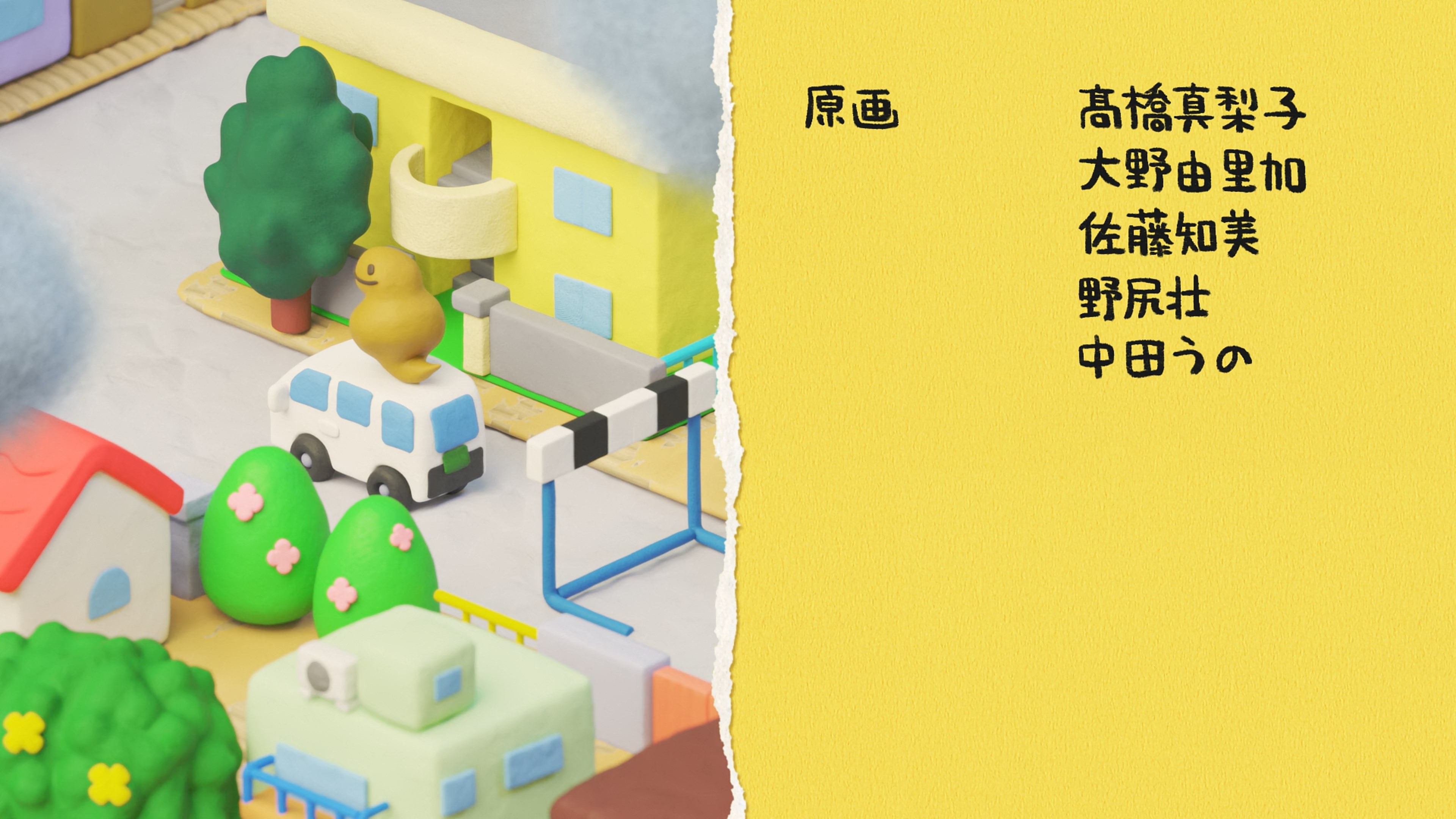
How do you make it up to an eccentric artist who couldn’t go all out with her personal idiosyncrasy within the show itself, then? You allow her to direct the ending, of course. Yamasaki followed suit and created a refreshing ending you might not find in a regular series, though rather than doing so with her awe-inspiring illustrations, this time she staged a Claymation-like sequence where we follow the many creatures that live in the titular city. Although the basis of it is CG animation (led by 3D director Tatsuki Kase), it appears to incorporate real materials as well, which is about what you’d expect from a team so adamant about trying out new techniques.
With all that knowledge about the team, we can finally sit back and enjoy their work across the first episode. Its amazing intro invites you to the city through Arawi’s amusing mythos, but also through those qualities of the key staff that we’ve been talking about. Just like in Yamasaki’s ending, we catch glimpses of mixed media usage to represent the passage of time in a creative way; it’s worth noting that she’s not credited in the first episode, so unless she has picked up Ishidate’s anonymous habits as well, the alternating layers of paintings and pencil colors were someone else’s work. And speaking of those two, the incredible cut that allows you to greet pretty much every inhabitant at the same time certainly feels like that type of shot we’ve seen Ishidate silently animate himself. So much for needing the opening sequences as an excuse to draw things moving, Mr. Director.
Self-serving as the assignment may have been, the choice to turn a spread illustration into such an involved cut embodies the director’s desire to beat Arawi at his own game. Sometimes, they’ll instead try to match the appeal of the source material in more straightforward ways, like reenacting its memorable isometric views of dozens of characters goofing around—already a daunting prospect when you must animate each and every one of them. They can even use rapid cutting to convey the feeling that a multitude of people are concurrently doing their own thing. But right at the beginning of the show, and especially for the type of shot that is so representative of CITY’s lively charm, they went the extra length to give it an impact you could only experience on this new, animated canvas.
After that statement of an introduction, the first skits in the show relish the weird peacefulness that the opening alluded to. It quickly becomes clear that one of the driving forces behind the choice to restructure the story was so that the viewers could enjoy that curious chill vibe, totally unlike the hectic majority of Nichijou. An aspect that has changed just as much, and maybe the one that will be most interesting to keep an eye on moving forward, is the way that Arawi’s imagination is rendered. To put it simply, Nichijou was all about compromise; the studio’s propensity towards grounded principles of character animation met in the middle with Arawi’s cartoony beliefs. The show navigated between those ends, defaulting to an evenly matched mix. One where you could still recognize Arawi, but also feel a slightly restrained version of the late Futoshi Nishiya’s anatomically-conscious approach.
That’s absolutely not the case with CITY, which operates according to what you may call Arawi Logic. Gone is that preoccupation with anatomy, and instead we get Tokuyama aiming for the stubby forms and perspective-breaking stylizations that are characteristic of the author. We alternate between reality and colorful voids where typography physically exists. The effects are exaggerated in quality yet simplified in depiction, unconcerned with matching the real principles that the studio’s animators usually keep in mind—being amusing is more important. Similarly, the predominant physics are the law of funny, according to which objects move in the most entertaining trajectory and rhythm possible. Every now and then, some naturalistic posing and true-to-life secondary motion will remind you that it’s indeed something animated by KyoAni’s team, but they really are challenging themselves with something that none of their previous comedic series had done; frankly, not that many TV anime ever.
Even when they want to integrate a more realistic concept, its execution maintains that cartoony, drawings-first attitude; you may have noticed that the first episode occasionally tries to portray elements as out of focus, doing so with sketchy lines rather than digitally. More recognizably KyoAni-like cuts are such a rarity that they’re treated as setups for gags, and even on their own, they’re made to fit this aesthetically pleasing cartoon world. This commitment to the visual identity strictly built around the original author’s style makes it feel like the best reimagination of Arawi’s style into animation, which is impressive given that Arawi is also an animator. But as Ishidate said, they intend to match and then surpass him in his own field, rather than in the neutral battlefield of Nichijou.
When talking about this process, Ishidate has referred to the challenge of filling the gaps. Within his comic, Arawi can jump around as he toys with onomatopoeia, impossible posing, multiples, and right about everything he can imagine—but what about animation, a much more sequential art form? If you want to be as inherently amusing as Arawi, you can’t draw the same thing he did. What you must do is imagine what the author would have drawn in between panels to connect them, and sometimes, within those singular drawings.
One of my favorite pages in the whole manga is during the first meeting with Wako, whose scatterbrained, eccentric nature is introduced through pauses and implied movement. In his storyboardStoryboard (絵コンテ, ekonte): The blueprints of animation. A series of usually simple drawings serving as anime’s visual script, drawn on special sheets with fields for the animation cut number, notes for the staff and the matching lines of dialogue., Ishidate plays off the same idea, but further complements it to compete with the original. What would Arawi have imagined if he were to animate Wako rummaging through her bag? Maybe, that at one point she’d find a cake inside it and eat it while still looking for something. And what if her palpitations could drag her through the street? Even before you start factoring in all the amusing ways to render all this animation, the small ideas themselves represent a desire to flesh out Arawi’s work without betraying its spirit.
In contrast to those details to increase the Arawi taste, Ishidate’s competitive spirit sometimes manifests through bold camerawork. The first scene isn’t the only moment where a sweeping camera gets us across the setting, something we also see when connecting the familiar outside of an apartment building with the location of yet another duo of weirdos. While these are deployed to impress the audience—again, Ishidate hates losing even to his friend—they also reinforce the feeling that by taking just a few steps, we’ll go from the location of a known character to another. Saying that CITY is all about every single inhabitant is easy, but applying that philosophy to the visual delivery sometimes takes a damn tricky shot to animate. Good thing the series directorSeries Director: (監督, kantoku): The person in charge of the entire production, both as a creative decision-maker and final supervisor. They outrank the rest of the staff and ultimately have the last word. Series with different levels of directors do exist however – Chief Director, Assistant Director, Series Episode Director, all sorts of non-standard roles. The hierarchy in those instances is a case by case scenario. loves those.
On a personal level, shots like this are also quite meaningful for Ishidate. In particular, his usage of rotations to build up tension during gags is extremely reminiscent of his mentor Kigami; you may have made the association between the ending for this scene and a certain Nichijou episode. There isn’t a single person at the studio who didn’t learn from Kigami, as he was well and truly an irreplaceable presence in the history of Kyoto Animation. And, across all those years, the closest thing to an heir for the studio’s mentor was Ishidate himself. A close pupil who first drew key animationKey Animation (原画, genga): These artists draw the pivotal moments within the animation, basically defining the motion without actually completing the cut. The anime industry is known for allowing these individual artists lots of room to express their own style. under him, someone who learned not just from his technique but also his behavior, as we’ve seen with those uncredited quirks. Eventually, an artist who developed a style of his own while rising to an equal rank of ace animator, before becoming a series directorSeries Director: (監督, kantoku): The person in charge of the entire production, both as a creative decision-maker and final supervisor. They outrank the rest of the staff and ultimately have the last word. Series with different levels of directors do exist however – Chief Director, Assistant Director, Series Episode Director, all sorts of non-standard roles. The hierarchy in those instances is a case by case scenario. as well. But even as they stood on the same level, he never stopped seeing him as someone to learn from. Watching Ishidate channel Kigami’s energy so clearly is a pleasant reminder that his influence will never fade.
As a whole, the first episode of this show feels like the kind of thing that could only be a short film, perhaps a commercial with creators gone rogue. Watching these creative ideas applied to an entire TV show, with the level of production values we’re dealing with, is nothing short of a glitch in the matrix. This first writeup has served us to scratch the surface of it all, but now that we’ve established how and why the series came to exist, further articles will allow us to get more into the specifics of each scene—as well as talking about the team beyond the main figures we’ve emphasized today, since smart leaders alone can’t sustain an entire project. As usual, we’ll also have to dedicate some time to talk about its production schedule and how that has affected the result we see on screen now. If you’re interested in that, tune back in… an indeterminate number of weeks, depending on how much the show pressures us to ramble about its greatness. Whether it’s just next week or after a few more episodes have passed, don’t worry, the coverage of CITY has only just begun.
Support us on Patreon to help us reach our new goal to sustain the animation archive at Sakugabooru, SakugaSakuga (作画): Technically drawing pictures but more specifically animation. Western fans have long since appropriated the word to refer to instances of particularly good animation, in the same way that a subset of Japanese fans do. Pretty integral to our sites’ brand. Video on Youtube, as well as this SakugaSakuga (作画): Technically drawing pictures but more specifically animation. Western fans have long since appropriated the word to refer to instances of particularly good animation, in the same way that a subset of Japanese fans do. Pretty integral to our sites’ brand. Blog. Thanks to everyone who’s helped out so far!
Become a Patron!
gdrivenime
Berita Olahraga
News
Berita Terkini
Berita Terbaru
Berita Teknologi
Seputar Teknologi
Drama Korea
Resep Masakan
Pendidikan
Berita Terbaru
Berita Terbaru
Berita Terbaru

