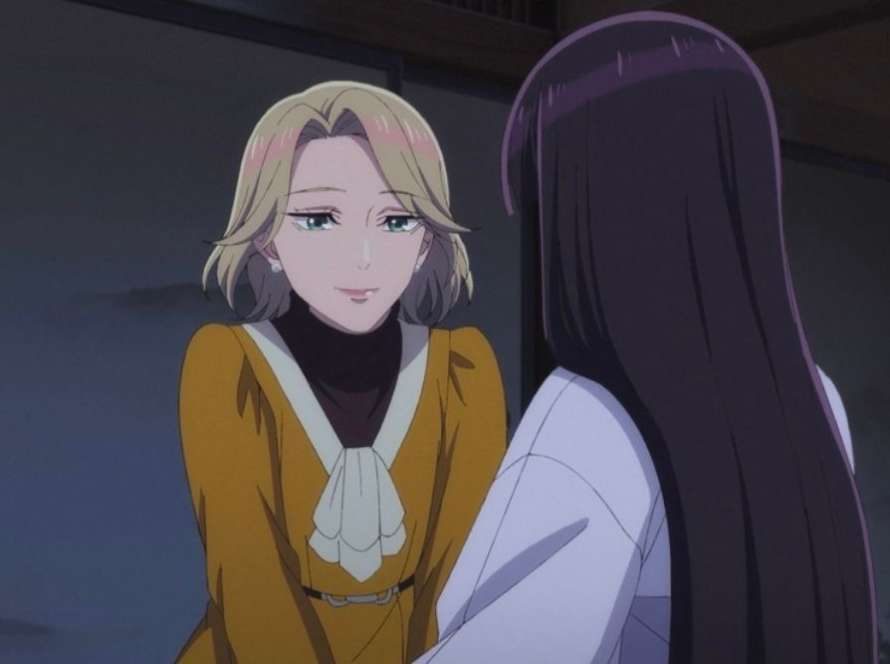

Kenji Nakamura is a disruptive, unique, truly avantgarde anime director. An ever-evolving creator whose mindset shifted 15 years ago when he directed Kuuchuu Buranko / Trapeze, despite having achieved amazing works by that point already. Even as he chases new forms of expression, that can still be felt in his new Mononoke films.
Calling Kenji Nakamura a unique anime director is an understatement. You don’t need to make it as far as his visually radical design sense, unusually grand preoccupations, and simply disruptive spirit to discern that. In truth, his upbringing and relationship with animation are already very different from your typical kid who drew as a kid and admired the cartoons he watched. As he admitted in the first entry of the Febri TALK column dedicated to him, Nakamura was a snotty brat who looked down upon all the boys and girls his age who enjoyed lowly pastimes like anime and tokusatsu. It wasn’t until Yoshiyuki Tomino’s Zambot 3 opened his eyes to the potential moral complexity animation can contain that he gave it a fair shake at all. After being disappointed that nothing matched it, it was Hayao Miyazaki’s willingness to challenge storytelling norms that finally hooked him.
Although this forced him to admit that he did in fact have a soft spot for anime, at the very least for the ones that spoke to him, it wasn’t enough to sway his career; Nakamura graduated from university and became a regular salaryman at an advertising agency, which may be as far as you can be from disruptive acts of creativity. Realizing years later that it may have been entirely the wrong choice for him, he enrolled at YoAni before finally hitting the anime industry in his mid-20s through a small support studio. As he mentioned in the next entry of his Febri coverage, that animation career was an extremely short one, since he quickly contracted tendonitis and thus had to give up on drawing all that much.
Instead, Nakamura switched to the role of production assistantProduction Assistant (制作進行, Seisaku Shinkou): Effectively the lowest ranking ‘producer’ role, and yet an essential cog in the system. They check and carry around the materials, and contact the dozens upon dozens of artists required to get an episode finished. Usually handling multiple episodes of the shows they’re involved with.. Once his studio connected with Toei Animation, he became a freelancer with increasingly stronger ties to the studio—eventually being treated as if he was an employee, in his own words. This granted him privileges he shouldn’t be meant to have, like acting as the assistant director for 2001’s Digimon Adventure 02: Revenge of Diaboromon; and we’re lucky that it happened, because that was a pivotal moment for his career. For starters, that type of favorable treatment has often followed him, and it’s important to understand why. Nakamura is simply the type of special talent that makes peers and producers with a keen eye give him opportunities one wouldn’t normally be granted. And that stands out a lot in contrast with his tendency as an irreverent, rowdy-in-his-youth creator to crash budgets and plans with no remorse.
You have to look no further than this Digimon project to find a perfect example of that duality. Being granted this opportunity meant, for example, that he’d be allowed to storyboardStoryboard (絵コンテ, ekonte): The blueprints of animation. A series of usually simple drawings serving as anime’s visual script, drawn on special sheets with fields for the animation cut number, notes for the staff and the matching lines of dialogue. the promotional video for the film—which would mean his very first storyboardStoryboard (絵コンテ, ekonte): The blueprints of animation. A series of usually simple drawings serving as anime’s visual script, drawn on special sheets with fields for the animation cut number, notes for the staff and the matching lines of dialogue. too. Nakamura did an excellent job that would justify that trust placed on him… but as he himself admitted to Febri, he went wildly over budget in the process (especially because of the amount of CGi he used) and got an earful about it. This contradictory status of teacher’s favorite and problem child has followed him arguably for his entire career, especially so when he was still figuring out the ropes in that era.
The production process for that teaser played another key role: it exposed Nakamura to the work of Mamoru Hosoda, whose storyboards for Digimon Adventure: Our War Game he randomly stumbled upon at the studio. Nakamura describes that discovery as a sudden exposure to a technique so refined it felt like a breakthrough, so it’s no surprise that he modeled his own storyboards after them. And he clearly did a good job, because Hosoda himself noticed it and would later invite him to his upcoming theatrical project. To this day, Nakamura still credits Hosoda not just stylistically, but in terms of attitude; the logical backbone that allows his projects to thrive in chaos rather than collapse under it comes from Hosoda’s calculated approach, as does his willingness to do a lot of research even if in the end it doesn’t all turn into usable materials.
As if to counterbalance Hosoda’s massive influence on him, Nakamura’s other key mentor also came into play in that era. Despite having gotten that opportunity with Diaboromon, Toei wasn’t built to give directorial opportunities to technical outsiders, so Nakamura tried his luck elsewhere; he has repeatedly mentioned in interviews that he’d set a deadline to lead an entire project and otherwise he would quit this industry, demonstrating that he’s always had that ardent desire to create his works. Climbing up the ladder is a sequential process, however, so he’d first have to make a name for himself as a storyboarder and episode director. To his credit, his short run on that role was one of the most impressive I’ve ever seen—and it had much to do with strolling into Tatsunoko Productions and meeting Keiichi Satou.
In his final Febri feature, dedicated precisely to this other mentor, Nakamura describes Satou as a very flexible individual who plays by the ear and has the innate ability to get away with it. If Hosoda had been a director who logically constructed a framework and then gave it entertaining flavor by removing pieces he knew weren’t necessary—we all know of his amusing abridgment of time and space—Satou’s approach is essentially the opposite. Within his more instinctual works, he works by addition rather than subtraction, packing them to the brim with the interesting ideas he might have on the spot; Nakamura exemplifies that nature by explaining how Sato entrusted him with The Soul Taker’s opening simply because he was around and looked free enough. Eventually, Nakamura’s identity as a series directorSeries Director: (監督, kantoku): The person in charge of the entire production, both as a creative decision-maker and final supervisor. They outrank the rest of the staff and ultimately have the last word. Series with different levels of directors do exist however – Chief Director, Assistant Director, Series Episode Director, all sorts of non-standard roles. The hierarchy in those instances is a case by case scenario. would be a fascinating mix of both of them. His delivery took Hosoda as the starting point, whereas on a design and conceptual level, he envisioned works on Satou’s scale and opted for his feeling of density.
Before reaching that point, the early to mid 00s were his time to grind as a director within other people’s works; effectively speedrunning that phase once he began being entrusted with storyboards, which helped others notice that he was a special individual. As mentioned earlier, Hosoda himself had already picked up on that so he decided to invite him to his upcoming film. Watching him draw storyboards was enlightening… but that didn’t last for long, since that project happened to be Hosoda’s version of Howl’s Moving Castle that never saw the light; one of the many up and downs of Nakamura’s career, and admittedly one that wasn’t self-inflicted in the least.
As noted in that final Febri interview, it was Satou who nonchalantly saved him at the time, taking his presence at the upcoming KARAS for granted. It’s easy to tell how much he trusted his pupil just by considering that the project—40th-anniversary title for Tatsunoko and thus kind of a big deal—was Satou’s baby to the point of planning, drafting, directing, and contributing to almost every storyboardStoryboard (絵コンテ, ekonte): The blueprints of animation. A series of usually simple drawings serving as anime’s visual script, drawn on special sheets with fields for the animation cut number, notes for the staff and the matching lines of dialogue.. And yet, he was willing to let Nakamura loose for the first episode and then collaborate with him on the finale as well. Their synergy (which admittedly required Nakamura to receive a crash course on tokusatsu) can be felt in its thrilling premiere, which draws you in with its sense of mystique, all sorts of perspective tricks in Nakamura’s storyboarding to go along with the questions about identity in the text, and one grand CG battle to kick things off.
At this point, you shouldn’t be surprised to hear that the experience also embodied Nakamura’s rocky relationship with studios; often willing to give him an opportunity because they sense something special, yet just as likely to regret his radical methods. This is to say that fingers were pointed at Nakamura for going over budget with his grand intro, which made him leave the studio… for the second time, as they’d already had friction during Soul Taker. Since then, Nakamura has been entrusted with multiple projects at Tatsunoko (including another anniversary one), and he’s also broken ties with them about as often. Acknowledging his greatness without considering this aspect doesn’t paint Nakamura’s full picture, and wouldn’t allow you to understand why the gap between his projects has grown increasingly larger, or why his TV shows ended up requiring multitudes of episode directors before that became tragically common.
In spite of that downside, Nakamura would continue to receive very attractive proposals, and it’s easy to see why. You can find his work in titles like Masaaki Yuasa’s Kemonozume, where he was in charge of the 10th episode. Even within the framework of another auteur, it’s easy to pick up on Hosoda’s influence in the way the episode is structured. Repetition is the name of the game, namely through the use of dou-poji—recurring layoutsLayouts (レイアウト): The drawings where animation is actually born; they expand the usually simple visual ideas from the storyboard into the actual skeleton of animation, detailing both the work of the key animator and the background artists. framing through the exact same position to establish a routine, often with the purpose of increasing the impact of watching it end. The mechanical and the emotional blend through his rhythm; in this case, it served to showcase the before and after of a tragedy, and to connect the flowers first seen in a recurring field with a final act done out of love yet leading to anything but happiness.

If there is one episode that can help you understand the Nakamura phenomenon, however, that would have to be Iriya no Sora #03. Despite happening extremely early in his storyboarding career, it’s a genuine masterpiece that greatly raises the bar for the show’s delivery. While this OVA series is fairly plain when it comes to its visual execution, Nakamura’s arrival as storyboarder and episode director changes that entirely.
At first glance, it’s easy to tell that it’s noticeably darker than the rest of the show, elevating its off-kilter feeling into an inexplicable low-key horror vibe. What’s most obvious in that regard is the change in compositing; Iriya no Sora is for the most part an ordinary effort for its time, but Nakamura’s approach is much more ambitious and involved, granting it a hazy look that better fits its mood (even with the technical aspects that haven’t aged as well). It’s night and day when compared to the regular look, and an interesting aspect to keep in mind when multiple Nakamura works later have ditched modern trends of emphasis on photorealistic postprocessing in favor of cel looks. More than having a single preference, he’s all about experimenting with new tools—as seen through his interest in 3DCG elements at the time too—to find situationally interesting solutions.
More than these surface-level aspects, and even beyond the extremely immersive layout work, it’s the evolution of that Hosoda-like rhythm that makes Iriya #03 such a fascinating episode. The idea of constructing by subtraction that he inherited from his mentor is expressed all over the episode, such as in the charming conversations filmed through repeating back and forths of the characters’ interactions with the world. That same idea of establishing a peaceful routine to shockingly deliver its destabilization you can find in Kemonozume #10 is present in this episode, most clearly in a locker shot that repeats even within itself—until it changes. Through these choices, you start seeing how Nakamura makes it into a language of his own; a focus on props rather than the overhead views Hosoda tends to employ for his dou-poji, approaching their material routines from a different angle, as well as deploying typography as another pacing mechanism. If you enjoy smart direction, this episode is a must-watch.
A certain producer at Toei Animation would agree with that claim as well. Hiroaki Shibata was a production assistantProduction Assistant (制作進行, Seisaku Shinkou): Effectively the lowest ranking ‘producer’ role, and yet an essential cog in the system. They check and carry around the materials, and contact the dozens upon dozens of artists required to get an episode finished. Usually handling multiple episodes of the shows they’re involved with. Nakamura encountered in his early days around Toei, and having become a producer by 2005, he was the one to invite him to Iriya. His bet paid off, since as he still recalls nowadays, episode #03’s excellence was what convinced him to grant Nakamura a series direction opportunity. That would manifest the very next year in the form of Ayakashi, a horror anthology that for the most part reimagined classic plays as directed by veterans from various fields.
You wouldn’t expect a newcomer like Nakamura to fit within that mold, let alone to be the one to deliver the climax through an original story, and he might have felt the same way; as Nakamura and the person who’d be his right-hand man explained in this web Animestyle interview, both of them hesitated until they were pressured to accept by their peers, and ultimately only gave the OK under the condition of working with each other as they’d sat together at Tatsunoko.
The result of that was Ayakashi’s renowned final tale: Bakeneko, spanning episodes #09 to #11. Although the previous self-contained stories have occasional flourishes for what is already an unusual space to explore in commercial TV animation, Bakeneko’s radical approach immediately feels like a different project altogether. Its commitment to ukiyo-e stylizations is as thorough as it is coherently linked to its Edo period setting and classic structure. That aesthetic in particular felt like a revelation at the time: dazzlingly modern for a 2006 mini-series to build around 3DCG elements and digital textures, and yet, employing those tools to evoke older forms of expression—both in making it feel like a parchment dynamically unfolding and in flattening a reality where everything appears like a cel element.
In Bakeneko, Nakamura greets you as the same brazen director from those storyboarder-for-hire stunts. Once again, rhythm is established through repetition, as is the humor. An aspect that he’s particularly good at is tying those recurring moments to specific sound effects and text that unfold in oddly satisfying ways, which turns these mechanical elements into another enjoyable aspect of Nakamura’s audiovisual prose.
The same director who was so interested in exploring the possibilities of CG animation—and so willing to blow up the budget recklessly in the process—is visible across its action sequences, which combine a deliberately chaotic sense of 3D space with traditionally excellent expression work. Due to the enclosed, fantastical tapestry that is the setting, Nakamura and company are able to disorient the viewer a bit without shattering any reality; the default level of abstraction is too high to object to these chaotic bursts. Those setpieces make excellent use of a weapon that he hasn’t always been able to maintain: the tremendous animation prowess of Toei-adjacent animators and related stars back then, with a special mention to one Takashi Hashimoto.
Although best known for his effects expertise, Hashimoto (with whom Nakamura had already collaborated in the likes of KARAS) was given the opportunity to act as character designer and concept artist for this work—a role that was so successful that he occupied a similar role in Nakamura’s next 3 projects as well. Bakeneko, and by extension the sibling TV show that would follow it up, was in many regards Hashimoto’s baby too; not only did he define that edgy look of its characters that allows them to morph into supernatural beings as if they were 2DFX as well, but he also had the tricky job of turning Nakamura’s abstract ideas into something tangible that could be comprehended by the rest of the team and the audience.
Hashimoto recalled as much a couple of years ago—unfortunately, he did so amid a civil war within the original team in the lead-up to its 15th-anniversary project, which reached unprecedented levels of public nastiness. What began with accusations of a planned betrayal to remove him from the project and unpaid work took a darker turn with the airing of personal health issues (physical and mental) with the involvement of producer Koji Yamamoto; which is to say, the face of noitaminA and one of Nakamura’s greatest allies both during that time with Fuji TV and later through Twin Engine. The situation was depressing and made everyone involved come out looking worse, but due to the sensitive nature of the topic, I’d rather not focus on it beyond an undeniable fact: Hashimoto was once integral to materializing Nakamura’s chaos in the memorable ways we all remember, but that relationship didn’t have a clean ending. If you’re aware of how much Hashimoto had advocated for granting the series a sequel, this outcome is a huge bummer.
Unaware of what would eventually happen, this team’s work in Ayakashi’s final arc established a formula so compelling that it’s no surprise they quickly got to iterate on it. The director’s unmistakable rhythm, using recurring shots and pseudo-diegetic sliding doors as commas and periods respectively, guides you through supernatural mysteries with a dash of horror. The one in charge of unraveling them is a wandering medicine seller, a mysterious person who formulates the method of resolution that becomes synonymous with this work: one must figure out the shape, truth, and reason behind a supernatural incident before being able to exorcise the spirit behind it.
As is often the case with youkai-themed tales, it’s human misdeeds that generate the dark feelings fueling those supernatural incidents, so the medicine seller must help process that rightful indignation too. “It was humans that made you what you are” is the actual text that accompanies his slaying of the titular bakeneko, which necessarily involves paying respect to the actual victims at the root of that story.
And so Nakamura, who had already landed this job because a producer was enamored with his style, delivered such a stylish (mini) series direction debut that he quickly landed its successor—2007’s Mononoke, a full TV show dedicated to the medicine seller’s adventures. Speaking to Animestyle for issue 008 many years later, Nakamura alluded to not feeling like that was an actual sequel; the short length of Ayakashi made it feel even to the director more akin to a pilot, making this TV show the first fully realized depiction of that concept.
As you’ll see if you follow his career from that point onward, or by checking out his interviews where he’s not shy about the topic, this is quite an important distinction in his view. After all, stepping up to the role of series directorSeries Director: (監督, kantoku): The person in charge of the entire production, both as a creative decision-maker and final supervisor. They outrank the rest of the staff and ultimately have the last word. Series with different levels of directors do exist however – Chief Director, Assistant Director, Series Episode Director, all sorts of non-standard roles. The hierarchy in those instances is a case by case scenario. gave Nakamura enough power to double down on an idea that is clearly natural to him: always make something truly new. All of his works are either fully original or such a revolutionary take on someone else’s story that they might as well be. If he’s ever in the position to direct a sequel, it’s a non-negotiable prerequisite that he has a new idea to convey. The fact that Mononoke TV was a straightforward stylistic and thematic continuation of Ayakashi, then, is further proof that it was still unfinished business for him.
That idea of Nakamura’s works holding a specific message that he always wants to feel fresh is also key to understanding the evolution of his career. In another interview with Animestyle, this time for issue 005, the director admitted feeling conscious of spelling out his thoughts; for as much as they abstractly resonated across the entire work, spelling out the message felt like admitting defeat. Nakamura amusingly summarized it by saying he used to create donut-shaped works; making a mold where you can intuit the shape but not proceeding with the casting in an explicit way, because he’d rather write around his message than convey it in remotely direct ways.

This approach made Mononoke one of the most stimulating works out there. Its predecessor’s style is refined, expanded into widescreen, and tested on more diverse settings this time around—although they’re all inevitably abstracted from a similar angle, which allows their team to flex their inventiveness when it comes to rendering new concepts and ideas. Combined with the alluring rhythm the director was known for, it turns the show into a succession of compelling pauses and exhilarating bursts of energy that follow Bakeneko’s formula; incidentally, that arc is reimagined into the final vignette within Mononoke, which makes the TV show feel like the complete expression of the director’s vision. Not one that retroactively renders Bakeneko’s original form moot, but a show worthy of being considered the definitive version of this concept.
On a thematic level, the director’s refusal to spell out the conclusion also makes for a satisfying experience; it’s a show that demands you meet it in the middle, but that rewards doing so. As it turns out, many people felt that way: Mononoke was, despite what you might have expected for such an idiosyncratic work, very successful. Its high viewership and very remarkable DVD sales are a great example of a phenomenon we’ve explored before—noitaminA was arguably at its most successful when it committed to its essence of an alternative outlet, both for audiences who were rarely catered to (like older women) and for avantgarde creators like Nakamura and Yuasa. Grasping the success of Bakeneko and Mononoke isn’t important simply to understand why they’ve been granted an entire theatrical trilogy to celebrate its 15th anniversary (17th by the time the first one has came out) but also how that immediately affected the director’s career.
As we mentioned earlier, Nakamura’s ambition had earned him a reputation as a threat to the budget; and being promoted to project leader had only increased his danger level, especially as he took that as an opportunity to become even more opposed to production norms. And yet, he had just landed a hit, with multiple producers now standing by him. That might help you understand how he ended up leading an adaptation of the works of popular author Hideo Okuda, who among many other genres dabbled into pop psychology for his Psychiatrist Irabu series. Those books alone have spawned a live-action film (In the Pool, 2005), two TV dramas (Kuuchuu Buranko in 2005 and Dr. Irabu Ichirou in 2011), theater plays, and even overseas reinterpretations. Without being a massive mainstream sensation, that was quite the popular title to be entrusted with.
In grand Nakamura fashion, his take on the series in the form of noitaminA’s Kuuchuu Buranko / Trapeze was completely unlike any other. Unfortunately, the popularity pendulum swung back and hit him when he was at his most confident; in the aforementioned Animestyle 008 interview, he explains that he thought he had invented a new genre and was ecstatic, then realized the reaction to his innovation wasn’t great. Mind you, Nakamura was perfectly justified in thinking that Kuuchuu Buranko was treading new ground; the show is set in a very real world as twisted through a pop-art filter, with paper-cut mobs and realistic designs that quick to become drawn-over pseudo rotoscope or outright live action beings. It’s a fever dream like few commercial anime have dared to be, even among Nakamura’s repertoire.

His transformative approach extends to the structure of the series as well. The glue holding together Okuda’s work was always Doctor Irabu: a sleazy psychiatrist that different patients attend across his anthologies, which turn the idea of helping oneself on its head via his nasty attitude and complete refusal to act according to protocol and social norms. Although Nakamura smoothes his character a little bit when compared to the novels, he twists the idea of the doctor in an interesting way by giving him three forms that correspond to Freud’s Id, Ego, and Superego; one is the colorful bear that tends to be shut inside his clinic in the hospital’s basement, one is a young child with a familiar plushie, and one a young adult with those same ears.
Irabu appears in different forms and situations, following patients in ways that make you wonder if he even exists—and that also make you wonder who has the more worrying psychosis, since his kink leads to a preposterous stock sequence where all patients get vitamin shots just to justify his urges. While he’s childish, arrogant, selfish, and dangerously impulsive, Irabu is also very quick to notice how societal pressures are the cause (or at least the amplifier) of many mental illnesses. His radical methodology, then, tends to be geared toward addressing the points of friction be it internal or with their surroundings; something that, in his view, sometimes involves a bit of domestic terrorism.
Expressing the psyche of those patients begins with another neat choice on a design level: giving them a colorful animal head that corresponds to their specific issues, which serves as a visual heads-up (no pun intended) when their problems flare up. Episode #05, brilliantly storyboarded by Nakamura’s friend Kiyotaka Suzuki, revolves around a fellow psychiatrist who is suffering from success. He’s married to the daughter of a hospital’s director and currently lives in their mansion, thus feeling forced to adapt to someone else’s high life. His urges to lash out and the self-defense mechanism that is forcefully adapting yourself to the environment, then, is expressed by occasionally turning into a chameleon—until Irabu’s influence finally lets him be himself at home, which improves everyone’s family life. On the other hand, episode #02 focuses on a man whose unresolved feelings for his ex-wife have led to a very different physiological problem. No need to explain why he becomes a rhino with a magnificent horn, I believe.
As you can tell by now, Kuuchuu Buranko is a very comedic series. However, between the subject matter and the renown of the title, Nakamura felt a pressure he hadn’t felt before. In this interview with IT Media, the director opens up about a reason why he decided to be particularly careful with this theme: someone close to him had already passed away because of mental health problems. Nakamura saw TV shows as something that anyone could casually tune into at any point, which was particularly true of a slot like noitaminA that aimed to appeal to non-core anime viewers. And if anyone can nonchalantly step into your world, wouldn’t you have to be tactful with an issue that can have such dark consequences? Conciliating that with his desire to make something bright and uplifting was one of his greatest challenges.
One of the strategies to conciliate the comedy with the gravity of those themes, besides focusing on less heavy conditions, was the inclusion of Fukuicchi. This funny cartoon man who always interjects to give advice, compliments Irabu’s talk about psychology, or outright contradicts him when he says something too outrageous is the avatar of a real, rather popular announcer at Fuji TV. Nakamura deployed him out of his sense of responsibility, but also as yet another way to modulate the rhythm in amusing ways—you never know when he may pop up again.
To achieve that, Nakamura relied on extensive research. He’d previously seen Hosoda’s dedication during pre-production, and so he applied the same fervor to interviewing psychologists, patients, and researching enough to realize that most information about mental health he’d see on television or circulating online was outdated. He told as much to noitaminA themselves, in an interview where he establishes Kuuchuu Buranko as a turning point for his whole career. He states that people with mental illnesses aren’t weak nor hopeless, and that if anything, they’re canaries in the coal mine of society. And that is the motif that he brilliantly built the entire adaptation around.
One of the greatest tricks executed by Nakamura and sies composer Manabu Ishikawa—another Tatsunoko connection who sadly passed last year—was to come up with points of connection between all patients. Originally, all the stories were self-contained, but the anime constantly places the eccentric protagonists of other episodes within the adventure you’re currently following. To begin with and despite sharing the title with a specific Okuda book, the team pulled stories out of all of Irabu’s published adventures at the time. Although the result is not the type of sappy story where absolutely everyone comes together in the end, new friendships do develop across the series, and you see the positive effect environments can have on your psyche if we’re all simply more respectful and conscious of others. This is expressed through the show’s wild audiovisual language, with all the tricks we’ve been highlighting since his previous works. And for some reason, a certain bird keeps flying around ever since the first time we stepped into Irabu’s office.
Chances are that you won’t really pay attention to the canaries in Kuuchuu Buranko. They appear consistently yet briefly, in a show that is so bursting with unique visuals that one bird won’t stand out. When Nakamura’s unsettling direction opens up the finale with a dead canary, though, things begin to turn. A previous case is revisited from the point of view of the father, which illuminates how it was his neglect of his family’s issues and their pleas for help that did the most damage.
His distant, uncaring stance is brilliantly depicted as childish and ultimately self-damaging too through the repetition Nakamura had become so good at using. While the show’s 2D animation is rarely a technical marvel, the likes of Yuki Hayashi, Masashi Kudo, and even the master Takeshi Honda himself appear to underline Nakamura’s new thesis for this work: the voices of his family he neglected to listen for the entire show were the canaries in the coal mine he tried to run away from. As a society, we ought to listen to them, not as weaklings who fall first but as heroes when compared to those who turn a blind eye to problems and minimize them. The show’s final statement goes to everyone who’s had any sort of mental health issue, telling them that they’re loved and that we’ve all been there at some point.
Now, this angle wasn’t a new one for Nakamura; it’s not a coincidence that Mononoke’s victims tended to be disenfranchised individuals, as the director used the fantastical setting to fire at unfair systems of power. Compared to the cryptic attitude he held back then, though, the sense of responsibility that he felt from Kuuchuu Buranko onwards made his message much more direct and explicit. His preoccupations with societal issues became more central as well, often being at the very core of those works.
Once again within noitaminA’s at the time still free environment, his worries about the economy—fueled by the global financial crisis—led to [C] The Money of Soul and Possibility Control. While much messier than its predecessor, Nakamura’s research not just with finance experts but with non-profit organizations that oppose the current system showed an interest in figuring out how the economy (further abstracted into ridiculous battles) affects actual people.
For his next shows, it was the idea of community that he explored the most. Tsuritama was born thanks to an Aniplex producer requesting him to make a show about adolescence with a male cast, but it wasn’t until he found this angle that it clicked for the director. Eccentric as some characters are, the diversity is meant to embody real groups of friends, while aspects like the physical rooting in the setting of Enoshima give it an authentic flavor. In terms of the delivery of these ideas, it’s worth highlighting that its more low-key direction was a successful experiment by Nakamura. That unique pacing from his previous works is something he calls rhythmic direction, with patterns and calculated yet stark shifts, while Tsuritama would be melodic direction; a natural flow, which he feels modern anime is disregarding and thus he feels more inclined to use now. If we’re looking at his evolution, this is another shift to keep in mind.
When reimagining another Tatsunoko icon for Gatchaman Crowds, Nakamura provided another example of his interest in communities—and also how fast his posture can change. During the 2011 Touhoku earthquake and tsunami, Nakamura observed how the internet allowed individuals to build the type of transversal systems of help that the government doesn’t necessarily provide. As a consequence, the adventures of its lively group of heroes have an optimistic outlook on online communities… which comes crashing down by the time of its sequel Gatchaman Crowds Insight. Rather than refuting its predecessor, Nakamura growing fed up with the proliferation of fake news and the culture of immediate, loud reactions to the news made him shed light on the other side of the coin. Insight is a warning against the power of mass media and of going with the flow, pushing back against the belief of unity as an absolute good; after all, it’s often fueled by intangible peer pressures and can do damage by stifling individual thoughts.
That thoughtfulness has accompanied Nakamura to this day, as have the difficulties of working with him—the 2015 to 2024 gap between his projects is quite telling in that regard. The director had to step down from Infini-T Force in 2017, which he was initially meant to direct rather than his pupil Suzuki. An original project that has been in the works since 2018, eventually adopting the codename Yotogi, never managed to materialize. Even among these titles that did come out, things weren’t necessarily easy; Crowds was a notorious production nightmare only rivaled by C, and Tsuritama’s higher stability (which couldn’t stop it from hitting a scheduling wall by the end) was only achieved because A-1 Pictures established a “Nakamura System” to shield themselves from those recurring issues.
When the stars align, however, Nakamura proves that he’s still got that special touch. And he does it in a way that maintains that general stance towards his role as director that he adopted with Kuuchuu Buranko. If you read any of the dozens of interviews that the director has given for Mononoke the Movie—a trilogy he has started releasing this year to culminate its 15th anniversary celebrations—then you most definitely have been told about the societal preoccupations motivating him this time. While he initially considered exploring the theme of peer pressure again, the way that idea was used during the heights of the pandemic made him want to find another theme to focus on. In the end, he settled on the fallacy of composition.
In socioeconomic terms, Nakamura sees that concept at its clearest in the application of policies like austerity. They are supposed to be good for the economy and thus everyone, and yet clearly impact people negatively on an individual level, which creates a dangerous mismatch. Back when he first led Mononoke TV, he limited himself to finding those individual voices and making them feel heard. Now that it’s easier to be heard because of the internet, though, he claims to want to soothe them and perhaps suggest solutions too.
Whether that ambitious goal will be successful or not is something that we’ll have to wait until the end of the trilogy to find out, but for now, we can already tell that Nakamura’s delivery is as bewitching as ever; and yet, it’s never exactly the way it was before. As if to make a point about his constant evolution, the director returns to a previous title and flips enough elements to give it a completely different flavor. His reveal that the medicine seller this time around is a different individual—and that there are countless of them—is only the tip of the iceberg. While still aiming for that ukiyo-e look, it’s clear right off the bat that we’re looking at parchment with way brighter pigment. The lines themselves have become Hokusai Blue, infusing the irotore with the theme of the series.
The most radical change, however, is once again related to the rhythm. More than ever before, Nakamura’s team is aiming for a sensorial overwork with a first entry in the trilogy that packs 2600 cuts in around 90 minutes of runtime; which translates to about twice as many of them as a regular movie would have, with most cuts lasting a couple seconds and only going up to 10. While Mononoke was always an intense experience, it allowed itself to be methodical at points—its unique style kept it visually engaging regardless—before its moments of acceleration, but this new take raises its baseline and accelerates even further in climactic moments. To best fit the theatrical format, those tend to be set in broader locations than the original show, which makes for some thrilling (if chaotic) setpieces. Even now, Nakamura proves he can change the flavor of anything he touches.

If you sign up to watch something led by Kenji Nakamura, chances are that it’ll feel unlike anything you’ve experienced before. The director himself will instinctively push in that direction, even on the rare occasion where he returns to a previous title—as we’ve seen with the fundamental change of pace for Mononoke. Just like the ever-changing audiovisual manifestations of the director’s ideas, his own mindset may change so fast that he’ll reach a rather different outlook on humanity altogether in-between one project and the next. In this sense, a title like Trapeze stands out as particularly special even among his unique works. While the likes of the medicine seller have had a stronger legacy among his viewers, it was the mad doctor Irabu who changed the way Nakamura perceives his role and responsibilities as a director of animation. And you know what, leaving such an imprint on one of the most notable figures in Japanese animation is quite the feat.
Support us on Patreon to help us reach our new goal to sustain the animation archive at Sakugabooru, SakugaSakuga (作画): Technically drawing pictures but more specifically animation. Western fans have long since appropriated the word to refer to instances of particularly good animation, in the same way that a subset of Japanese fans do. Pretty integral to our sites’ brand. Video on Youtube, as well as this SakugaSakuga (作画): Technically drawing pictures but more specifically animation. Western fans have long since appropriated the word to refer to instances of particularly good animation, in the same way that a subset of Japanese fans do. Pretty integral to our sites’ brand. Blog. Thanks to everyone who’s helped out so far!
Become a Patron!